Philippe Leroyer | Flickr (CC BY-NC-ND 2.0)

Análisis Especiales

AWID es un organización feminista internacional de membresía, que brinda apoyo a los movimientos que trabajan para lograr la justicia de género y los derechos de las mujeres en todo el mundo.

Defensorxs de Derechos Humanos

Lxs defensorxs se identifican a sí mismas como mujeres y personas lesbianas, bisexuales, transgénero, queer e intersex (LBTQI) y otrxs que defienden derechos y que debido a su trabajo en derechos humanos están bajo riesgos y amenazas específicos por su género y/o como consecuencia directa de su identidad de género u orientación sexual.

Lxs defensorxs son objeto de violencia y discriminación sistemáticas debido a sus identidades y su inclaudicable lucha por derechos, igualdad y justicia.

El Programa Defensorxs colabora con contrapartes internacionales y regionales así como con lxs afiliadxs de AWID para crear conciencia acerca de estos riesgos y amenazas, abogar por medidas de protección y de seguridad que sean feministas e integrales, y promover activamente una cultura del autocuidado y el bienestar colectivo en nuestros movimientos.


Riesgos y amenazas dirigidos específicamente contra lxs defensorxs

lxs defensorxs enfrentan los mismos tipos de riesgos que todxs lxs demás defensorxs de derechos humanos, de comunidades y del medio ambiente. Sin embargo, también están expuestas a violencia y a riesgos específicos por su género porque desafían las normas de género de sus comunidades y sociedades.

Por defender derechos, lxs defensorxs están en riesgo de:

  • Ataques físicos y muerte
  • Intimidación y acoso, incluso en los espacios virtuales
  • Acoso judicial y criminalización
  • Agotamiento

Un enfoque integral y colaborativo de la seguridad

Trabajamos de manera colaborativa con redes internacionales y regionales y con nuestrxs afiliadxs

  • para crear conciencia de las violaciones de derechos humanos contra lxs defensorxs y de la violencia y discriminación sistemáticas que enfrentan
  • para fortalecer los mecanismos de protección y asegurar respuestas más oportunas y efectivas para lxs defensorxs que están en riesgo

Trabajamos para promover un enfoque integral de la protección que incluya:

  • remarcar la importancia del autocuidado y el bienestar colectivo, y reconocer que el significado de cuidado y bienestar puede variar entre las diferentes culturas;
  • documentar las violaciones dirigidas contra lxs defensorxs usando una perspectiva feminista interseccional;
  • promover el reconocimiento y celebración social del trabajo y la resiliencia de lxs defensorxs; y
  • construir espacios ciudadanos que conduzcan al desmantelamiento de las desigualdades estructurales sin restricciones ni obstáculos.

Nuestras acciones

Nos proponemos contribuir a un mundo más seguro para lxs defensorxs, sus familias y comunidades. Creemos que actuar por los derechos y la justicia no debe poner en riesgo a lxs defensorxs, sino que debe ser valorado y celebrado.

  • Promoviendo la colaboración y coordinación entre organizaciones de derechos humanos y organizaciones de derechos de las mujeres en el plano internacional para fortalecer la capacidad de respuesta en relación a la seguridad y el bienestar de lxs defensorxs.

  • Apoyando a las redes regionales de defensorxs y de sus organizaciones, tales como la Iniciativa Mesoamericana de Mujeres Defensorxs de Derechos Humanos y la WHRD Middle East and North Africa  Coalition [Coalición de Defensorxs de Derechos Humanos de Medio Oriente y África del Norte], promoviendo y fortaleciendo la acción colectiva para la protección, poniendo el énfasis en establecer redes de solidaridad y protección, promover el autocuidado y la incidencia y movilización por la seguridad de lxs defensorxs.

  • Aumentando la visibilidad y el reconocimiento de lxs defensorxs y sus luchas, así como de los riesgos que enfrentan, a través de la documentación de los ataques que sufren, e investigando, produciendo y difundiendo información sobre sus luchas, estrategias y desafíos.

  • Movilizando respuestas urgentes de solidaridad internacional para lxs defensorxs que están en riesgo a través de nuestras redes internacionales y regionales y de nuestrxs afiliadxs activxs.

Contenido relacionado

Snippet FEA Objectives NSS Advocacy (EN)

INCIDENCIA POLITICA

Yellow circle with illustration of a brown woman with a white t-shirt holding a blue loudspeaker.
Influir en tomas de decisiones políticas y promover un acceso más equitativo a la tierra para las mujeres que trabajan en la agricultura

Snippet - WITM Start the survey 1 - PT


Globe

O inquérito está disponível em árabe, inglês, francês, português, russo e espanhol!


WHRDs from the South and Southeast Asian region

7 Women Human Rights Defenders from across the South and Southeast Asian region are honored in this year’s Online Tribute. These defenders have made key contributions to advancing human and women’s rights, indigenous people’s rights, and the right to education. These WHRDs were lawyers, women’s rights activists, scholars, and politicians. Please join AWID in commemorating t their work and legacy by sharing the memes below with your colleagues, networks and friends and by using the hashtags #WHRDTribute and #16Days. 


Please click on each image below to see a larger version and download as a file


Su’ad Al-Ali

Su’ad was a strong advocate of women’s and children’s rights, and was the head of Al-Weed Al-Alaiami - an Iraqi human rights organisation.

She participated in the July 2018 demonstrations that took place in Basra and several other Iraqi cities protesting unemployment and demanding jobs and proper public services for citizens, as well as calling for the elimination of rampant corruption.

On 25 September 2018, Su’ad was assassinated in the Al-Abbasiyah district in downtown Basra. A video of the incident showed a person approaching her as she was getting into her car, firing a bullet at the back of her head and pointing another bullet at her driver Hussain Hassan, who was injured in the shoulder. Al-Ali was 46 and the mother of four children.


Su'ad Al Ali, Iraq

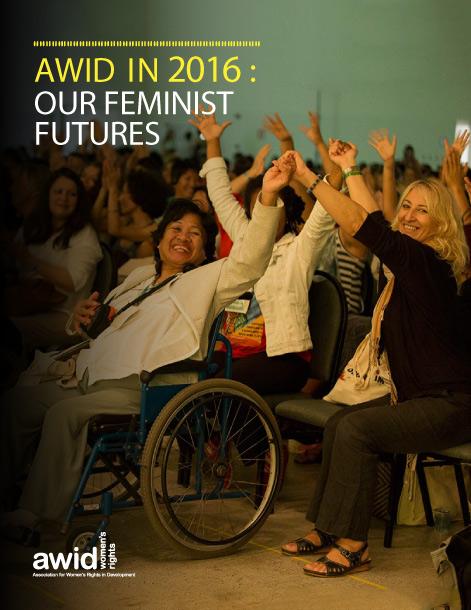
AWID in 2016: Co-Creating Feminist Futures

AWID is pleased to share our 2016 Annual Report.

2016 was an incredible year for AWID, we convened the 13th International AWID Forum in Bahia, Brazil, a space for strategizing and alliance building with feminists and other justice movements, which was attended by over 1800 participants from 120 countries and territories across the globe.

We know that women’s rights and feminist movements are key actors in creating sustainable transformative change. Within our movements, organizing, resisting and responding to the challenging context is sharpening, and in our increasingly connected world, the potential for collective action across diverse movements has dramatically grown.

This is the crucial work that AWID seeks to amplify and support every day.


What we achieved in 2016

We expanded solidarity and joint action across diverse movements

A highlight of 2016 was our ground-breaking 13th International Forum with the theme: “Feminist Futures: Building Collective Power for Rights and Justice”, where we harnessed the thinking and energy of nearly 500 partners, presenters, panelists, moderators, artivists, writers, facilitators, IT innovators, and performers, many of them leaders in their movements. We also supported the convening of the first and historical Black Feminisms Forum (BFF) organised by a working group of Black Feminists from across the world.

We strengthened knowledge of issues and strategies

We contributed to collective advocacy

AWID, in partnership with other feminist and women’s rights organisations, engaged in advocacy and dialogue to explore better solutions for women’s rights agendas including our work with the Count Me In! consortium .

We increased the visibility of movements

The experiences of women with disabilities, Black and Afro-descendant women, sex workers, Indigenous women, trans and intersex people, domestic workers and how their lives are impacted by multiple oppressions and violence were placed front and center of the Forum process.

We also launched the 2016 WHRD Tribute to commemorate defenders who are no longer with us, during the 16 Days of activism, and thanks to the contributions from our members,

We drove attention to groups and issues that do not usually receive adequate mainstream media coverage through our partnership with The Guardian and Mama Cash.


Our members


Snippet FEA Audio A Caring Economy (FR)

Snippet - WITM about research - AR

عن استطلاع "أين المال"

استطلاع "اين المال" (أين التمويل للتنظيمات النسوية) هو ركيزة أساسية للنسخة الثالثة لأبحاثنا الموجهة نحو العمل. سيتم بحث وتوسيع نتائج الاستطلاع من خلال المحادثات العميقة مع النشطاء/ الناشطات والممولين/ات وسيتم مقارنة النتائج مع تحليلات وبحوث أخرى عن وضع التمويل للحركات النسوية وحركات العدالة الجندرية.

سيتم نشر تقرير أين المال للتنظيمات النسوية في العام 2026.

لمعرفة المزيد عن كيف تسلّط جمعية حقوق المرأة في التنمية الضوء على على تمويل التنظيمات النسوية أو ضدها، انظروا إلى قصة "أين المال" وتقارير سابقة هنا

Before you begin

Before starting the WITM research methodology, it is important you prepare the background and know what to expect.


Capacity

With AWID’s WITM research methodology, we recommend that you first review the entire toolkit.

While this toolkit is designed to democratize WITM research, there are capacity constraints related to resources and research experience that may affect your organization’s ability use this methodology.

Use the “Ready to Go?” Worksheet to assess your readiness to begin your own WITM research. The more questions you can answer on this worksheet, the more prepared you are to undertake your research.

Trust

Before beginning any research, we recommend that you assess your organization’s connections and trust within your community.

In many contexts, organizations may be hesitant to openly share financial data with others for reasons ranging from concerns about how the information will be used, to fear of funding competition and anxiety over increasing government restrictions on civil society organizations.

As you build relationships and conduct soft outreach in the lead-up to launching your research, ensuring that your objectives are clear will be useful in creating trust. Transparency will allow participants to understand why you are collecting the data and how it will benefit the entire community.

We highly recommend that you ensure data is collected confidentially and shared anonymously. By doing so, participants will be more comfortable sharing sensitive information with you. 


First step

1. Gather your resources

We also recommend referring to our “Ready to Go?” Worksheet to assess your own progress.

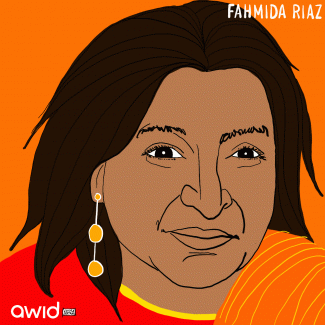
Fahmida Riaz

“Afterwards
After love the first time,
Our naked bodies and minds
A hall of mirrors,
Wholly unarmed, utterly fragile,
We lie in one another's arms
Breathing with care,
Afraid to break
These crystal figurines.” - Fahmida Riaz

Fahmida Riaz broke social taboos by writing about female desire in her poetry, creating alternative narratives about women’s bodies and sexuality, and setting new standards in Urdu literature.

Her work faced harsh criticism from conservatives, who accused her of using erotic and “pornographic” expressions in her poetic language. 

Fahimida was eventually blacklisted and charged with sedition under Section 124A of the Pakistan Penal Code) during the dictatorship of Zia Ul Haq. Forced into exile in 1981, she spent almost seven years in India before returning to Pakistan. 

As part of the preface to “Badan Dareeda” ('The Torn-Bodied'), a collection of poetry published in 1974, she wrote: 

If, indeed, I am forced to stand before this maqtal today and face the gallows, I should face them with my head held high. My poems are the trace of a mangled head: emanating sounds even as it is suspended from ropes... A Body Torn has taken the form of a razmia, or the sound of rupture. And if such rupture indeed shocks a people, then consider the poet as having achieved her purpose: she has managed to disturb them. (translation from Urdu by Asad Alvi)

The brilliance of Fahmida was in defying any singular logic or categories of gender, nation, religion or culture. She refused to be put in the role of a ‘woman poet’, breaking with traditional definitions of feminine poetry and concepts and themes (ranging from political consciousness, body, culture, desire, religion, home) and knocking down inhibitions put on her gender. 

“You have to understand that culture can have no essence. Cultures move, flowing into one another, forming new cultures. Culture is born this way. There is no clash of cultures.” 

Fahmida authored more than 15 books on poetry and fiction including her poem ‘Taaziyati Qaraardaaden’ (‘Condolence Resolutions’) that might serve as an appropriate tribute to her life and legacy and a collection of poems (Apna Jurm To Saabit He ‘My Crime Stands Proven’) published in 1988 during her time in exile. 

Fahmida Riaz was born in Meerut, India on 28 July 1946 and passed away on 21 November 2018 in Lahore, Pakistan.

2021: Feminist Power in Action

In 2021, AWID, along with many other organizations, was coming to grips with the implications of the on-going global pandemic for how we work and our role in this particular time. The year taught us three critical lessons about navigating this moment as a global feminist movement-support organization.

Download the full 2021 Annual review


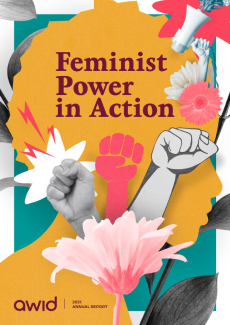
English language cover for the 2021 AWID Annual Report. It shows a collage of protests fists raised, along with flowers and a silhouette of a person with short hair in the back.

Through dialogue and exchanges critical to their work, AWID connected thousands to feminists from around the world.

Our experience in 2021 reaffirmed the importance of building and sustaining a global feminist community, and AWID’s core mission to support feminist movements as a whole. We believe that at this moment, a strong community bound by a shared vision and collective care is the foundation of all social change and transformation.

Download the full 2021 Annual review

Snippet FEA In numbers (EN)

IN NUMBERS

Por que devo considerar responder ao inquérito?

Existem várias razões pelas quais a sua resposta ao inquérito WITM é importante. Por exemplo, tem a oportunidade de partilhar a sua experiência vivida com a mobilização de financiamento para apoiar a sua organização; de reivindicar o seu poder como especialista sobre como o dinheiro circula e os bolsos em que entra; e de contribuir para a defesa coletiva e consistente junto de financiadores para mover mais recursos de maior qualidade. Ao longo das últimas duas décadas, o inquérito WITM da AWID tem-se revelado um recurso fundamental para ativistas e financiadores. Convidamo-lo a juntar-se a nós na sua terceira edição para destacar o estado efetivo do financiamento, desafiar soluções falsas e apontar a forma como o financiamento precisa de mudar para que os movimentos prosperem e enfrentem os desafios complexos do nosso tempo.

4. Collect and analyze your data

This section will guide you on how to ensure your research findings are representative and reliable.

In this section:

Collect your data

1. Before launch

  • First determine the best way to reach your survey population.
    For example, if you want to focus on indigenous women’s rights organizers, do you know who the key networks are? Do you have contacts there, people who can introduce you to these organizations or ways of reaching them?
  • Determine if your key population can be easily reached with an online survey, if you need to focus on paper survey distribution and collection or a mix of both. This decision is very important to ensure accessibility and inclusiveness.
  • Be prepared! Prior to advertizing, create a list of online spaces where you can promote your survey.
    If you are distributing paper versions, create a list of events, spaces and methods for distributing and collecting results.
  • Plan your timeline in advance, so you can avoid launching your survey during major holidays or long vacation periods.
  • Make it easy for your advisors and partners to advertize the survey – offer them pre-written Twitter, Facebook and email messages that they can copy and paste.

2. Launch

  • Send the link to the survey via email through your organization’s email databases.
  • Advertize on your organization’s social media. Similar to your newsletter, you can regularly advertize the survey while it is open.
  • If your organization is hosting events that reach members of your survey population, this is a good space to advertize the survey and distribute paper versions as needed.
  • Invite your advisors to promote the survey with their email lists and ask them to copy you so you are aware of their promotional messages. Remember to send them follow-up reminders if they’ve agreed to disseminate.
  • Approach funders to share your survey with their grantees. It is in their interest that their constituencies respond to a survey that will improve their own work in the field.

3. During launch

  • Keep the survey open for a minimum of four weeks to ensure everyone has time to take it and you have time to widely advertize it.
  • Send reminders through your email databases and your partners databases asking people to participate in the survey. To avoid irritating recipients with too many emails, we recommend sending two additional reminder emails: one at  midway point while your survey is open and another a week before your survey closes.
  • As part of your outreach, remember to state that you are only collecting one response per organization. This will make cleaning your data much easier when you are preparing it for analysis.
  • Save an extra week! Halfway through the open window for survey taking, check your data set. How have you done so far? Run initial numbers to see how many groups have responded, from which locations, etc. If you see gaps, reach out to those specific populations. Also, consider extending your deadline by a week – if you do so, include this extension deadline in one of your reminder emails, informing people know there is more time to complete the survey. Many answers tend to come in during the last week of the survey or after the extended deadline.

If you also plan to collect data from applications sent to grant-making institutions, this is a good time to reach out them.

When collecting this data, consider what type of applications you would like to review. Your research framing will guide you in determining this.

Also, it may be unnecessary to see every application sent to the organization – instead, it will be more useful and efficient to review only eligible applications (regardless of whether they were funded).

You can also ask grant-making institutions to share their data with you.

See a sample letter to send to grant-making institutions

Back to top


Prepare your data for analysis

Your survey has closed and now you have all this information! Now you need to ensure your data is as accurate as possible.

Depending on your sample size and amount of completed surveys, this step can be lengthy. Tapping into a strong pool of detail-oriented staff will speed up the process and ensure greater accuracy at this stage.

Also, along with your surveys, you may have collected data from applications sent to grant-making institutions. Use these same steps to sort that data as well. Do not get discouraged if you cannot compare the two data sets! Funders collect different information from what you collected in the surveys. In your final research report and products, you can analyze and present the datasets (survey versus grant-making institution data) separately.

1. Clean your data

  • Resolve and remove duplications: If there is more than one completed survey for one organization, reach out to the organization and determine which one is the most accurate.
  • Remove ineligible responses: Go through each completed survey and remove any responses that did not properly answer the question. Replace it with “null”, thus keeping it out of your analysis.
  • Consistently format numerical data: For example, you may remove commas, decimals and dollar signs from numerical responses. Financial figures provided in different currencies may need to be converted.

2. Code open-ended responses

There are two styles of open-ended responses that require coding.

Questions with open-ended responses

For these questions, you will need to code responses in order to track trends.

Some challenges you will face with this is:

  1. People will not use the exact same words to describe similar responses
  2. Surveys with multiple language options will require translation and then coding
  3. Staff capacity to review and code each open-ended response.

If using more than one staff member to review and code, you will need to ensure consistency of coding. Thus, this is why we recommend limiting your open-ended questions and as specific as possible for open-ended questions you do ask. 

For example, if you had the open-ended question “What specific challenges did you face in fundraising this year?” and some common responses cite “lack of staff,” or “economic recession,” you will need to code each of those responses so you can analyze how many participants are responding in a similar way.

For closed-end questions

If you provided the participant with the option of elaborating on their response, you will also need to “up-code” these responses.

For several questions in the survey, you may have offered the option of selecting the category “Other” With “Other” options, it is common to offer a field in which the participant can elaborate.

You will need to “up-code” such responses by either:

  • Converting open-ended responses to the correct existing categories (this is known as “up-coding”). As a simple example, consider your survey asks participants “what is your favorite color?” and you offer the options “blue,” “green,” and “other.” There may be some participants that choose “other” and in their explanation they write “the color of the sky is my favorite color.” You would then “up-code” answers like these to the correct category, in this case, the category “blue.”
  • Creating a new category if there are several “others” that have a common theme. (This is similar to coding the first type of open-ended responses). Consider the previous example question of favorite color. Perhaps many participants chose “other” and then wrote “red” is their favorite. In this case, you would create a new category of “red” to track all responses that answered “red.”
  • Removing “others” that do not fit any existing or newly created categories.

3. Remove unecessary data

Analyze the frequency of the results

For each quantitative question, you can decide whether you should remove the top or bottom 5% or 1% to prevent outliers* from skewing your results. You can also address the skewing effect of outliers by using median average rather than the mean average. Calculate the median by sorting responses in order, and selecting the number in the middle. However, keep in mind that you may still find outlier data useful. It will give you an idea of the range and diversity of your survey participants and you may want to do case studies on the outliers.

* An outlier is a data point that is much bigger or much smaller than the majority of data points. For example, imagine you live in a middle-class neighborhood with one billionaire. You decide that you want to learn what the range of income is for middle-class families in your neighborhood. In order to do so, you must remove the billionaire income from your dataset, as it is an outlier. Otherwise, your mean middle-class income will seem much higher than it really is.

Remove the entire survey for participants who do not fit your target population. Generally you can recognize this by the organizations’ names or through their responses to qualitative questions.

4. Make it safe

To ensure confidentiality of the information shared by respondents, at this stage you can replace organization names with a new set of ID numbers and save the coding, matching names with IDs in a separate file.

With your team, determine how the coding file and data should be stored and protected.

For example, will all data be stored on a password-protected computer or server that only the research team can access?

Back to top


Create your topline report

A topline report will list every question that was asked in your survey, with the response percentages listed under each question. This presents the collective results of all individual responses. 

Tips:

  • Consistency is important: the same rules should be applied to every outlier when determining if it should stay or be removed from the dataset.
  • For all open (“other”) responses that are up-coded, ensure the coding matches. Appoint a dedicated point person to randomly check codes for consistency and reliability and recode if necessary.
  • If possible, try to ensure that you can work at least in a team of two, so that there is always someone to check your work.

Back to top


Analyze your data

Now that your data is clean and sorted, what does it all mean? This is the fun part where you begin to analyze for trends.

Are there prominent types of funders (government versus corporate)? Are there regions that receive more funding? Your data will reveal some interesting information.

1. Statistical programs

  • Smaller samples (under 150 responses) may be done in-house using an Excel spreadsheet.

  • Larger samples (above 150 responses) may be done in-house using Excel if your analysis will be limited to tallying overall responses, simple averages or other simple analysis.

  • If you plan to do more advanced analysis, such as multivariate analysis, then we recommend using statistical software such as SPSS, Stata or R.
    NOTE: SPSS and Stata are expensive whereas R is free.
    All three types of software require staff knowledge and are not easy to learn quickly.

Try searching for interns or temporary staff from local universities. Many students must learn statistical analysis as part of their coursework and may have free access to SPSS or Stata software through their university. They may also be knowledgeable in R, which is free to download and use.

2. Suggested points for analysis

  • Analysis of collective budget sizes
  • Analysis of budget sizes by region or type of organization
  • Most common funders
  • Total amount of all funding reported
  • Total percentages of type of funding (corporate, government, etc)
  • Most funded issues/populations
  • Changes over time in any of these results.

Back to top


Previous step

3. Design your survey

Next step

5. Conduct interviews


Estimated time:

• 2 - 3 months

People needed:

• 1 or more research person(s)
• Translator(s), if offering survey in multiple languages
• 1 or more person(s) to assist with publicizing survey to target population
• 1 or more data analysis person(s)

Resources needed:

• List of desired advisors: organizations, donors, and activists
• Optional: an incentive prize to persuade people to complete your survey
• Optional: an incentive for your advisors

Resources available:

Survey platforms:

• Survey Monkey
• Survey Gizmo (Converts to SPSS for analysis very easily)

Examples:
• 2011 WITM Global Survey
• Sample of WITM Global Survey
• Sample letter to grantmakers requesting access to databases

Visualising Information for Advocacy:
• Cleaning Data Tools
• Tools to present your data in compelling ways
• Tutorial: Gentle Introduction to Cleaning Data


Previous step

3. Design your survey

Next step

5. Conduct interviews


Ready to Go? Worksheet

Download the toolkit in PDF

Navleen Kumar

"No era una persona. Era una potencia". - Así recuerda unx compañerx activista a Navleen Kumar.

Nacida el 15 de octubre de 1994, Navleen Kumar fue una ferviente activista por el derecho a la tierra y la justicia social de la India.

Con integridad y compromiso, trabajó durante más de una década para proteger y restaurar las tierras de los pueblos indígenas (adivasi) en el distrito de Thane, un área arrebatada por los propietarios y promotores inmobiliarios a través de medios como la coerción y la intimidación. Luchó contra esta injusticia y estos crímenes a través de intervenciones legales en diferentes tribunales, y descubrió que la manipulación de los registros de las tierras era una característica recurrente en la mayoría de los casos de adquisición de terrenos. En uno de los casos, el de los Wartha (una familia tribal), Navleen descubrió que la familia había sido engañada con la complicidad de funcionarixs gubernamentales.

Así, a través de su trabajo, ayudó a restituir la tierra a la familia Wartha, y siguió dedicándose a otros casos de transferencias de tierras adivasi.
 
"Su  artículo sobre el impacto de la alienación de la tierra en las mujeres y las niñas y niños adivasi traza la historia y las complejidades de la alienación tribal desde la década de los 70, cuando las familias de clase media comenzaron a trasladarse a los suburbios de Mumbai, que se extendían mientras el valor de la propiedad en la ciudad aumentaba de forma exponencial.

Los complejos de viviendas proliferaron en estos suburbios, y lxs integrantes de las comunidades tribales, que eran analfabetxs, pagaron el precio por ello. El costo de las tierras de primera, cerca de las líneas de ferrocarril, alcanzó un precio elevado y los constructores se abalanzaron sobre este cinturón como buitres, arrebatando de forma ilegal las tierras a las comunidades tribales y otrxs residentes locales ". - Jaya Menon, Comisión de Justicia y Paz.

Durante el curso de su activismo, Navleen recibió numerosas amenazas y sobrevivió a varios atentados contra su vida. A pesar de ello, siguió trabajando no sólo en lo que era importante para ella, sino que además contribuyó a cambiar la vida y la realidad de las muchas personas a las que apoyó en su lucha por la justicia social.

Navleen murió apuñalada el 19 de junio de 2002 en su edificio de departamentos. Dos gánsteres locales fueron arrestados por su asesinato.

Demo article

Snippet Intro The Feminist Realities Magazine (ES)

La revista de las Realidades Feministas

Las Realidades Feministas proclaman y personifican la esperanza y el poder.

Las encontramos en todo lo que nos muestra que existen otras formas de vivir, de pensar y de hacer,  desde las expresiones cotidianas que se evidencian en cómo nos relacionamos con otrxs hasta los sistemas alternativos de gobernanza y de justicia. Las realidades feministas son formas de resistencia a sistemas de poder como el patriarcado, el capitalismo y la supremacía blanca. 

Son propuestas poderosas que nos orientan hacia la idea de lo que es posible y nos muestran cómo los procesos de organización feminista están abriendo caminos hacia la justicia en movimientos y comunidades de todo el mundo. 

Descargar la revista completa (PDF)

Explorar la revista

نحن نعيد إعطاء المال لشركائنا/شريكاتنا ونعرّف عن أنفسنا كنسويات و\ أو صندوق نسائي. هل علينا تعبئة الاستطلاع؟

كلا. نقدّر عملكم/ن لكننا لا نطلب في هذه المرحلة من الصناديق النسوية والنسائية تعبئة الاستطلاع. نشجعكم/ن على مشاركة الاستطلاع مع شركائكم/ن و شبكاتكم/ن النسوية.