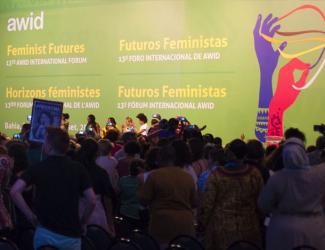
Foro de AWID: Co-creando futuros feministas
En septiembre de 2016, 1800 feministas y activistas por los derechos de las mujeres de todos los rincones de nuestros movimientos se congregaron en las costas de Bahia, en el 13º Foro Internacional de AWID.
En esta sección se destacan los logros, los aprendizajes y los recursos que surgieron de las ricas conversaciones mantenidas. Te invitamos a analizar, compartir y comentar.
¿Qué ha pasado desde 2016?
Uno de los aportes más importantes del Foro fue la necesidad de ampliar y profundizar nuestro trabajo entre movimientos, frente a la confluencia de los fascismos en auge, fundamentalismos, codicia corporativa y cambio climático.
Con esto en mente, AWID, en asociación con múltiples aliadxs, ha estado trabajando para que estas semillas de resistencia:
-
Nuestras Iniciativas Semilla han ayudado a 20 ideas que surgieron en el Foro para crecer en forma de acciones concretas
-
El vídeo «Defendiendo a las Personas y al Planeta» y la guía «Tejiendo la resistencia a través de la acción» estan protagonizados por defensoras de derechos humanos y presentan estrategias concretas para confrontar al poder corporativo
-
Con nuestras animaciones El estado de nuestros movimientos feministas y Justicia climática y ambiental, los movimientos ahora tienen herramientas creativas para apoyar su trabajo.
-
La compilación de las expresiones artísticas «Los Movimientos Importan», sigue inspirando una organización más fuerte y creativa en todo el mundo.
-
Los movimientos también pueden beneficiarse de nuevas metodologías para imaginar nuestros futuros feministas (¡pronto!)
AWID se ha comprometido, mediante su próximo plan estratégico y su proceso del Foro, a continuar y profundizar las relaciones, las lecciones y los procesos iniciados en el Foro 2016 y basándonos en el momento actual.
¿Que pasa ahora?
El mundo es un lugar muy diferente de lo que era un año atrás, y seguirá cambiando en los próximos años.
El próximo Foro de AWID se realizará en la región del Pacífico Asiático (el lugar y la fecha exactos serán anunciados en 2018). Esperamos que te unas a nosotrxs.
El próximo Foro de AWID se realizará en la región del Pacífico Asiático (el lugar y la fecha exactos serán anunciados en 2018). Esperamos que te unas a nosotrxs.
Sobre el Foro de AWID
Los Foros de AWID comenzaron en 1983 en Washington DC. Desde entonces, el evento ha crecido hasta convertirse en muchas cosas para muchas personas: un proceso iterativo para darle forma a nuestros análisis, objetivos y acciones; un hito crucial que fortalece los feminismos de lxs participantes e infunde energías a sus procesos de organización; un hogar político donde lxs defensoras de derechos humanos encuentran un santuario y solidaridad.
Contenido relacionado
Mi pregunta no está respondida aquí
Para preguntas adicionales, por favor utiliza nuestro formulario de contacto. ¡Continuaremos actualizando este documento en base a las consultas que vayamos recibiendo de ustedes!
Snippet Kohl - Plénière | Le plaisir au-delà des frontières
Avec Lindiwe Rasekoala, Lizzie Kiama, Jovana Drodevic et Malaka Grant.
Ressources des mouvements féministes

L'enquête "Où est l'argent?" #WITM est maintenant en ligne ! Plongez dans l'enquête et partagez votre expérience du financement de votre organisation avec des féministes du monde entier.
En savoir plus et participer à l’enquête!
Les mouvements féministes, en faveur des droits des femmes et leurs allié-e-s du monde entier s’opposent au pouvoir et imaginent de nouvelles politiques de libération. Des ressources économiques et politiques aux actes quotidiens de résistance et de survie, les contributions qui viennent nourrir ce travail revêtent de nombreuses formes.
L’initiative de l’AWID, Ressources des mouvements féministes (Resourcing Feminist Movements, RFM), met en lumière l’écosystème de financement actuel, qui va des modèles d’attribution des ressources auto-générée aux voies de financement officielles.
A travers nos recherches et analyses, nous examinons de quelles façons les pratiques de financement pourraient mieux servir nos mouvements. Nous faisons une étude critique des contradictions propres au “financement” de la transformation sociale, compte tenu notamment de la répression politique croissante, des programmes anti-droits et du pouvoir grandissant des entreprises. Mais surtout, nous élaborons des stratégies collectives en appui à des mouvements fleurissants, solides et résilients.
Nos Actions
Reconnaissant la richesse de nos mouvements et répondant au contexte actuel, nous oeuvrons à:
-
Créer et élargir les alternatives : Nous développons les pratiques de financement qui accordent une place prépondérante aux priorités des activistes et impliquons un large éventail de donateurs et d’activistes dans la création de nouveaux modèles dynamiques d’attribution de ressources en faveur des mouvements féministes, en particulier dans un contexte qui voit l’espace de participation de la société civile diminuer considérablement.
-
Enrichir nos connaissances : Nous explorons, échangeons et consolidons nos connaissances sur la façon dont les mouvements attirent, organisent et utilisent les ressources qui leur sont nécessaires pour entreprendre des changements significatifs.
-
Plaider : Nous travaillons en partenariat, comme avec le Count Me In! Consortium, afin d’influencer les programmes de financement et permettre aux mouvements féministes d’être en dialogue direct pour déplacer le pouvoir et l’argent.
Contenido relacionado
Margarita Salas Guzmán
Biography
Margarita est une militante féministe et LGBTIQA d'Amérique latine. Elle est passionnée de transformation sociale et de bien-être collectif. Elle est titulaire de diplômes en psychologie, communication et en administration publique, ainsi que de certificats en politiques publiques, leadership, gestion et prise de décision. Durant son parcours professionnel, Margarita a acquis une vaste expérience auprès d'organisations de terrain, d'ONG nationales et régionales, d'universités et du secteur public, développant la facilitation, le renforcement des capacités, le plaidoyer politique, la communication et l'évaluation des politiques.
Position
Cheffe de Projets Spéciaux
Add to stories
Off
Clone of Snippet FEA Title Menu (FR)
Les Économies Féministes
QUE NOUS ADORONS
ÉCONOMIES DES SOINS AGROÉCOLOGIE ET SOUVERAINETÉ ALIMENTAIRECOOPÉRATIVISME FÉMINISTESYNDICALISME FÉMINISTE
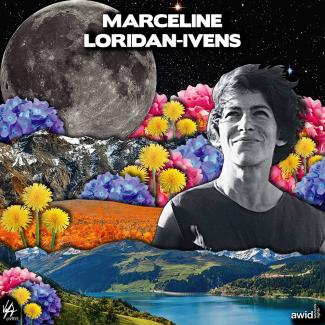
Marceline Loridan-Ivens
Born in 1928, Marceline worked as an actress, a screenwriter, and a director.
She directed The Birch-Tree Meadow in 2003, starring Anouk Aimee, as well as several other documentaries. She was also a holocaust survivor. She was just fifteen when she and her father were both arrested and sent to Nazi concentration camps. The three kilometres between her father in Auschwitz and herself in Birkenau were an insurmountable distance, which she writes about in one of her seminal novels “But You Did Not Come Back.”
In talking about her work, she once said: "All I can say is that everything I can write, everything I can unveil — it's my task to do it.”
CFA 2023 - Online and Hybrid - EN
New
Online & Hybrid
As an online participant, you can facilitate activities, connect and converse with others, and experience first-hand the creativity, art and celebration of the AWID Forum. Participants connecting online will enjoy a rich and diverse program, from workshops and discussions to healing activities and musical performances. Some activities will focus on connection among online participants, and others will be truly hybrid, focusing on connection and interaction among online participants and those in Bangkok.
Snippet Kohl - Intro EN

Feminists have long asserted that the personal is political. Crear, Resister, Transform Festival created spaces for feminists to discuss issues around body, gender and sexualities, and explored the interconnections of how these issues are both deeply embodied experiences, and simultaneously a terrain where rights are constantly disputed and at risk in society.
The power of feminist movements lie in how we organise and take coordinated action, not only amongst our own communities and movements, but with allied social justice causes and groups. This space provided opportunities for movements to share and strengthen organizing and tactical strategies with each other.
The COVID-19 global health pandemic has made the failures of neo-liberal capitalism even more apparent than ever before, exposed the cracks in our systems, and highlighted the need and opportunities to build new realities. A feminist economic and social recovery requires all of us to make it together. This journal edition in partnership with Kohl: a Journal for Body and Gender Research, will explore feminist solutions, proposals and realities for transforming our current world, our bodies and our sexualities.
Explore the articles online or
Download PDF
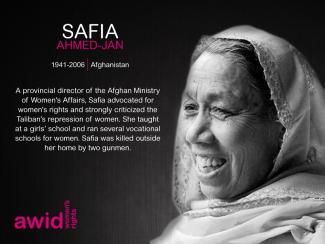
Safia Ahmed-Jan
Faye Macheke
Biography
Faye is a passionate Pan-African feminist, active in movements for women's rights, racial justice, migrant and labor rights, and environmental justice. Her activism builds on the legacy of the struggle against apartheid in South Africa and the aftermath of the apartheid era in Zimbabwe.
In 2019, Faye joined AWID as the Director of Finance, Operations and Development, and strived to ensure that AWID upholds the feminist principles and values in all of its operations. She brings over 20 years of experience in feminist leadership, strategy, and all aspects of finance and organizational development.
Faye is a committed Board Member of UAF-Africa and other women's rights organizations. She previously held a Head of Finance and Operations roles at Paediatric Adolescent Treatment for Africa and JASS - Just Associates Inc. in Southern Africa. She also held Directorship roles for International Computer Driving Licence (ICDL) in Central and Southern Africa. She holds a Bcompt in Accounting Science from University of South Africa and is a member of the Southern African Institute for Business Accountants.
Position
Co-Executive Director
Add to stories
Off
WITM - Refreshed INFOGRAPHIC 1 FR
Vous êtes-vous déjà demandé à quoi ressemblaient les budgets des organisations féministes ?
En 2023, le budget annuel médian des organisations féministes et de défense des droits des femmes était de 22 000 USD. Cette médiane masque de profondes inégalités : quelques groupes accèdent à des ressources considérables, tandis que la grande majorité survit avec des budgets très limités.
Un examen plus attentif des budgets réels révèle une immense diversité et une grande disparité dans les revenus.
Explorez les données relatives à la taille des budgets féministes
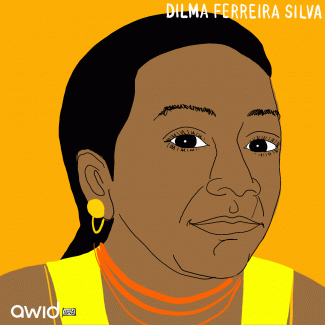
Dilma Ferreira Silva
Dilma Ferreira Silva was a leading Amazonian rights activist who fought for decades for the rights of people affected by dams.
She herself was among the 32,000 people displaced by the Tucuruí, a mega-hydroelectric power plant, built in Brazil during the 1964-1985 military dictatorship.
In 2005 Dilma was invited to join the Movement of Dam-Affected Peoples in Brazil (MAB), and in 2006 she formed the women’s collective, eventually becoming regional coordinator of the movement.
In speaking about her activism, her colleagues commented:
“She stood out very fast because she was always very fearless in the struggle.”
Dilma lived in the rural settlement of Salvador Allende,50 kilometers from Tucuruí, and dedicated her life to better protect communities and the land affected by the construction of mega projects. She was especially concerned with the gendered impacts of such projects and advocated for women’s rights.
At a national MAB meeting in 2011, Dilma spoke to women affected by the dams, saying:
“We are the real Marias, warriors, fighters who are there, facing the challenge of daily struggle”.
In the following years, Dilma organized grassroots MAD groups and worked with the community to form farming cooperatives that created a better distribution of food for the community. They improved the commercialization of fishing, and developed a cistern project for safe drinking water. She was also an advocate for farmers whose lands were being coveted by ‘grileiros’ (land grabbers).
On 22nd March 2019, at the age of 48, Dilma, her husband and their friend were all brutally murdered. The three killings came as part of a wave of violence in the Amazon against the Movimento dos Trabalhadores Sem Terra (translates as ‘landless workers’ movement’), environmental and indigenous activists.
CFA 2023 - Themes - EN

Themes
We welcome applications across the full range of thematic areas and intersections important to feminist and gender justice movements. In the application form, you will be able to mark more than one theme that fits your activity.
- Free Bodies, Free Spirits: all things bodily autonomy, gender and sexuality, reproductive health and rights, freedom from gender-based violence, freedom to live in safety, pleasure and joy in our diverse bodies, identities and communities, and much, much more.
- Resisting Anti-Rights: locally and globally, feminists are leading the way in resisting all forms of intersectional oppressions, including fascisms, fundamentalisms, and authoritarian regimes; we have a lot to share and strategize with each other about.
- Movements and Organizing: let us get to know each other’s movements. From navigation of power (internal and external) to protection strategies in the face of the repression of women and gender-diverse human rights defenders, from alliance-building to creative and successful forms of organizing, let’s learn and be inspired by each other.
- Economic Justice and Feminist Economies: this theme encompasses all feminist efforts to transform our economies, from challenging dominant extractive models and defending labor rights to embodying and living feminist economic practices and alternatives in everyday life.
- Funding/Resourcing Activism: securing much-needed funding is a shared challenge for movements across the world; let us together unpack the feminist funding ecosystem, from critical analysis to first-hand experiences and practical ways to fund feminist work.
- Climate, Environmental Justice, Land and Water: ecological and climate justice has deep roots in many of our movements and communities; from ancient traditions to futuristic visions, from ecology villages to campaigns to end extractivism and health justice, we invite a full scope of activities on all aspects of climate and environmental justice.
- Militarization, War and Conflict: we aim to spotlight feminist organizing, analysis and experiences often on the frontline of crisis response and helping to sustain life, community and justice in the harshest times of war and protracted conflict.
- Decolonization: decolonization is central to each and every one of our themes, yet it also stands on its own, as a key feminist agenda of resistance and world-building in many colonial and post-colonial realities.
- Digital Realities and Feminist Tech: we welcome an opportunity to celebrate the incredible feminist initiatives that transform digital worlds, challenge big tech power structures, and democratize technology as truly by and for the people.
- Healing Justice: there is an incredible diversity of approaches to collective care and healing justice. Worldwide, healers and movements are reclaiming healing justice as a political principle, a set of practices, a learning journey, a way of life, and much more.
- Add your theme here!
Sexting Like a Feminist: Humor in the Digital Feminist Revolution Snippet Small
Sexting Like a Feminist: Humor in the Digital Feminist Revolution
by Chinelo Onwualu
On September 2nd, 2021, the amazing feminist and social justice activists of AWID’s Crear | Résister | Transform festival came together not only to share resistance strategies, co-create, and transform the world, but also to talk dirty on Twitter.
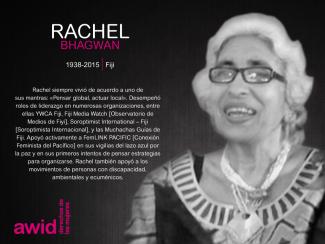
Rachel Bhagwan
Juhi
Biography
Juhi es una entusiasta de las tecnologías. Posee una licenciatura en Ingeniería Informática de la Universidad Tecnológica de Gujarat y formación de posgrado en Telecomunicaciones Inalámbricas y Gestión de Proyectos del Instituto Universitario Humber. Apasionada de la resolución de problemas y de mantenerse a la vanguardia en el panorama tecnológico en constante evolución, Juhi se ha encontrado recorriendo diversas industrias como técnica en Tecnologías de la Información. Ha tenido oportunidad de aplicar sus competencias técnicas en distintos entornos, siempre abrazando los nuevos desafíos con entusiasmo. Más allá de los códigos y los circuitos, le encantan las aventuras de la vida. Explorar nuevos lugares y culturas es para ella una bocanada de aire fresco. Ya sea que se trate de descubrir alguna joya oculta en la ciudad, de probar algún plato exótico o de embarcarse en algún deporte de aventura, Juhi siempre está predispuesta a vivir nuevas experiencias.
Position
Coordinadora, Apoyo en Tecnologías de la Información
Add to stories
Off
Snippet - COP30 - Links
$2.7 trillion for the military. $300 billion for climate justice. We're here to flip the script.
Get started with these resources.
COP30 Political Education Toolbox Play the Climate Justice Organizing Deckgame
Read the Feminist Economic Alternatives Brief Download the Climate Justice Zine
Molara Ogundipe
"Pero, ¿ fue el maestro alguna vez
seducido por el poder?
¿Alguna vez se rompió
un sistema con aceptación ?
¿Cuándo el JEFE te entregará el poder con amor?
¿En Jo'Burg, en Cancún o en la ONU? - Molara Ogundipe
En una entrevista, realizada en la Feria Internacional del Libro de Ghana de 2010, Molara Ogundipe se presentó con estas palabras "...Soy una nigeriana. He vivido, posiblemente, en todo el mundo, excepto en la Unión Soviética y China".
A través de los diferentes continentes y países, la profesora Ogundipe enseñó literatura comparada, escritura, género y filología inglesa, y utilizó la literatura como vehículo para la transformación social y el replanteamiento de las relaciones de género.
Molara Ogundipe, como pensadora, escritora, editora, crítica social, poeta y activista feminista, logró combinar el trabajo teórico con la creatividad y la acción práctica. Se la considera una de las principales voces críticas de los feminismos africanos, los estudios de género y la teoría literaria.
Molara acuñó el concepto de "estiwanismo" a partir de las siglas STIWA (Social Transformations in Africa Including Women) [Transformaciones Sociales en África Incluyendo a las Mujeres], con el fin de reconocer la necesidad de “alejar la definición del feminismo y los feminismos en relación con Euro-América u otro lugar, y declamar lealtades o deslealtades". Con su obra fundamental, "Recreándonos Nosotras Mismas", de 1994, Molara Ogundipe (publicada bajo el nombre de Molara Ogundipe-Leslie) dejó tras de sí un inmenso cuerpo de conocimientos que descolonizó el discurso feminista y "re-centró a las mujeres africanas en sus completas y complejas narrativas... guiadas por una exploración de la liberación económica, política y social de las mujeres africanas y la restauración de la agencia femenina en las diferentes culturas de África".
Comentando los retos a los que se enfrentó como joven académica, dijo:
"Cuando empecé a hablar y escribir sobre el feminismo a finales de los años sesenta y en los setenta, se me veía como una chica buena y admirable que se había extraviado, una mujer cuya cabeza se había arruinado con un exceso de aprendizaje".
Molara Ogundipe se destacó por su liderazgo a la hora de combinar el activismo con el mundo académico; en 1977 fue una de las fundadoras de la Asociación de Mujeres en la Investigación y el Desarrollo, AAWORD (por sus siglas en inglés),. En 1982 fundó Mujeres en Nigeria, WIN (por sus siglas en inglés), con el fin de abogar por un acceso pleno a los "derechos económicos, sociales y políticos" para las mujeres nigerianas. Posteriormente, estableció y dirigió la Fundación Internacional para la Educación y el Monitoreo y pasó muchos años en el consejo editorial del periódico The Guardian.
Luego de haber crecido con el pueblo yoruba, sus tradiciones, cultura e idioma, dijo una vez:
"Creo que la celebración de la vida, de las personas que mueren después de una vida llena de logros, es uno de los aspectos más hermosos de la cultura yoruba".
El nombre de alabanza yoruba 'Oiki' de Molara era Ayike. Molara nació el 27 de diciembre de 1940 y falleció el 18 de junio de 2019 a la edad de 78 años, en Ijebu-Igbo, Estado de Ogun, Nigeria.
Clone of CFA 2023 - Hybrid like never before: in person - EN
In-person
Participants will come together in Bangkok, Thailand. We can’t wait!