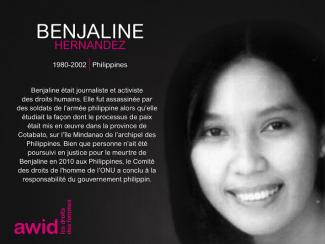
Benjaline Hernandez
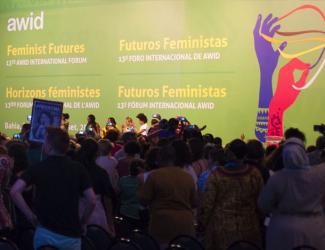
En septembre 2016, 1800 féministes et défenseur-e-s des droits des femmes venu-e-s des quatre coins de nos mouvements se réunissaient sur les côtes de Bahia à l’occasion du 13ème Forum international de l’AWID.
Cette section met l’accent sur les victoires, les enseignements et les ressources qui ont couronné nos conversations. Nous vous invitons à l’explorer, la partager et laisser vos impressions.
L’un des principaux éléments à retenir de ce Forum a été la nécessité d’élargir et d’approfondir notre travail de collaboration entre mouvements pour faire face à une montée des fascismes et des fondamentalismes, une exacerbation de la cupidité des entreprises et un changement climatique en progression.
Nos Initiatives Jeunes-pousses ont aidé 20 idées émérgées au Forum à évoluer en actions concrètes
La vidéo « Protéger les personnes et la planète » et le guide « Arrimer la résistance à l'action » mettent en lumière le courage des défenseur-e-s des droits humains et présentent des stratégies concrètes pour résister au pouvoir des entreprises
Avec nos animations L'état de nos mouvements féministes et La justice climatique et environnementale, les mouvements ont maintenant des outils créatifs pour appuyer leur travail de plaidoyer.
La compilation des expressions artistiques des mouvements continue d’inspirer une organisation plus forte et plus créative dans le monde entier.
Les mouvements peuvent aussi bénéficier d’une nouvelle méthodologie pour envisager nos horizons féministes. (à venir bientôt !)
A travers son prochain plan stratégique et le processus de son Forum, l’AWID s’engage à poursuivre et approfondir les rapports, les apprentissages et les processus amorcés lors du Forum 2016, tout en s’inspirant de l’actualité.
Les Forums de l’AWID ont vu le jour en 1983, à Washington DC. Depuis, ils revêtent de nombreux aspects et incarnent, selon les personnes, tantôt un processus itératif visant à affiner nos analyses, notre vision et nos actions, un évènement clé galvanisant les féminismes des participant-e-s et leurs organisations ou un espace politique offrant refuge et solidarité aux défenseur-se-s des droits humains.
«Este sería un buen momento para repensar cómo podría ser la revolución. Quizás no sera una marcha por las calles de cuerpos enojados y sin discapacidades. Quizás será más como el mundo detenido porque todos los cuerpos que hay en él están exhaustos: porque el cuidado debe ser priorizado antes de que sea demasiado tarde.»
- Johanna Hedva
Los hospitales son instituciones, espacios vivientes del capitalismo, y lo que se manifiesta cuando alguien está supuestamente haciendo reposo allí es un microcosmos del sistema en que vivimos.
Las instituciones están organizadas para separarnos de nuestros sistemas de cuidados: en ellas nos encontramos aisladxs en estructuras rígidamente jerárquicas, y a menudo sentimos como si ese cuidado fuera algo que se nos hace a nosotrxs, en lugar de algo dado/recibido como parte de una conversación. Debido a su integración en la demanda capitalista, el cuidado institucional está compartimentado: una persona trata tu pierna y solo tu pierna, otra persona trata tu presión arterial, etc.
El mes pasado, la fotógrafa Mariam Mekiwi tuvo que someterse a una cirugía y documentó el proceso. Sus imágenes de entornos esterilizados (luces blancas de neón, filas y filas de estructuras repetitivas), con una paleta de colores desteñidos, reflejan un lugar que estaba vaciado de vida y de movimiento. Esta fue una de las formas en que Mariam mantuvo vivo su propio espíritu. Era una forma de protesta desde dentro de los confines de una institución con la cual tenía que interactuar.
Las fotos constituyen un retrato de algo increíblemente vulnerable, porque observar a alguien atravesar el colapso de su propio cuerpo es siempre un recordatorio sagrado de nuestra fragilidad. Son también un testimonio de la fragilidad de estos sistemas de cuidado, que nos pueden ser negados por diversas razones: desde no tener dinero hasta no estar en un cuerpo considerado lo suficientemente valioso, un cuerpo que es quizás demasiado femenino, demasiado queer, o demasiado marrón.
El cuidado experimentado como algo desencarnado y solitario, que puede ser revocado en cualquier momento, no nos ayuda a prosperar. Y es muy diferente del modo en que los seres humanos se comportan en la realidad cuando cuidan unos de otros. ¿En qué sería diferente nuestro mundo si nos comprometiéramos a desmantelar las actuales estructuras capitalistas referidas a nuestra salud? ¿Cómo sería nuestro mundo si lo reinventáramos en forma radical?
During her 38-year career, Debbie Stothard, has worked with diverse communities and activists to engage states, IGOs and other stakeholders throughout Asia, Africa, Europe, and the Americas on human rights and justice. Her work is focused on the thematic priorities of business and human rights, atrocity prevention, and women’s leadership. Accordingly, she has either facilitated or been a resource person at nearly 300 training events in the past 15 years. Most of these were grassroots-oriented workshops delivered in the field, focused on human rights advocacy, economic literacy and business and human rights, and transitional justice and atrocity prevention. Her work in transitional justice and atrocity prevention has mainly focused on Burma/Myanmar, however she has provided advice on responses to other country situations around the world.
During 1981 – 1996, Debbie worked as a crime reporter, student organizer, policy analyst, academic, government advisor and food caterer in Malaysia and Australia while volunteering for human rights causes. In 1996, she founded ALTSEAN-Burma which spearheaded a range of innovative and empowering human rights programs. This includes ALTSEAN’s ongoing intensive leadership program for diverse young women from Burma, which in the past 22 years, has helped strengthen and expand women’s leadership in conflict-affected zones. She served as a member of the Board of the International Federation for Human Rights (FIDH) for 9 years as Deputy Secretary-General (2010-2013) and Secretary-General (2013 – 2019) during which she promoted the mission and profile of FIDH at approximately 100 meetings and conferences per year.
|
Consejo editorial Co-editorxs Diseño e ilustración Estratega de las comunicaciones Editora de la versión árabe Responsable de la traducción
Corrección |
Traducciones árabes
Corrección
Corrección |
Jemimah Naburri-Kaheru est une stratège internationale accomplie en matière de ressources humaines à impact profond dans la région de la Corne de l'Afrique. Jemimah était auparavant responsable régionale des ressources humaines et du bureau de l'Initiative stratégique pour les femmes dans la Corne de l'Afrique (SIHA) . Son influence s’est étendue jusqu’à la direction des ressources humaines de plus de 70 employé·e·s régionaux·ales, alors que l'organisation connaissait une croissance rapide, avec une augmentation de 40 % de ses revenus annuels. Tout au long de sa carrière, Jemimah a orchestré avec succès des efforts de recrutement, introduit des systèmes de performance basés sur le mérite, de même que supervisé les relations avec les employé·e·s et les politiques RH. Elle a joué un rôle central dans le soutien aux stratégies mondiales de personnel. Avec une formation universitaire en Études de Développement de l'Université de Makerere (Ouganda) et un Master en Gestion des Ressources Humaines, Jemimah est évidemment engagée envers le développement professionnel. Sa contribution à des effectifs hautement performants et à un leadership international en matière de ressources humaines la positionne comme un atout inestimable dans toute entreprise mondiale.
عندما كنت في السادسة من العمر، علِمت أنّ جدّي كان يملك داراً للسينما. أخبرَتني أمّي كيف أنه افتتحها في أوائل الستينيّات، وكانت هي حينها في مثل عمري، إذ كان عمرها قُرابة الستّ سنوات. تذكّرتُ أنهم في الليلة الأولى عرضوا فيلم «صوت الموسيقى».

Khaoula Ksiksi is a passionate advocate for justice, equity, and liberation. As a Gender, Equality, Diversity, and Inclusion (GEDI) Advisor, she works to make inclusivity a lived reality, not just a policy, across humanitarian programs and crisis contexts. She collaborates with teams to challenge structural oppression using bold, transformative tools rooted in lived experience.
Her activism began on the frontlines of Tunisia’s anti-racism movement. With Mnemty, she helped push through the country’s first anti-discrimination law, forcing a national reckoning with racial injustice. She later co-founded Voices of Black Tunisian Women to amplify Black women’s leadership, build solidarity networks, and demand visibility in a society that often silences them.
Khaoula is also a founding member of Falgatna, a radical queer-feminist movement fighting for SOGIESC rights and supporting LGBTQI+ communities through direct action, digital resistance, and survivor-centered advocacy.
Previously, she led regional feminist and climate justice projects at the Rosa Luxemburg Foundation in North and West Africa.
At the heart of her work is a deep belief: no one is free until we all are. Her activism is both a fight and a love letter to her people, her communities, and the world we deserve.
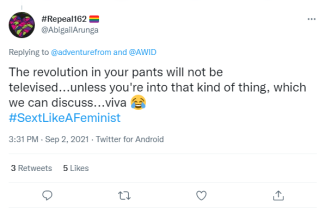
تَلفَزَتُنا للثورة تحت حزامك مشروطة بطبيعة رغباتك
The AWID Forum has always been a space that doesn’t shy away from much needed and difficult conversations. We welcome these submissions when the organizers can carefully hold a respectful and safer space for the participants.
Cinthia has collaborated with NGOs in Mexico, Peru, and Ecuador on projects related to human mobility, the environment, and political advocacy through transmedia storytelling and web development. She holds a Master’s in Visual Anthropology from FLACSO Ecuador and a degree in Animation and Digital Art from Tecnológico de Monterrey. She loves experimenting with code and visual media to craft new forms of storytelling and keep exploring the intersection between art, technology, and social change.
Upasana is a non binary illustrator and artist based out of Kolkata, India. Their work explores identity and personal narratives by using a visual remnant or evidence of the contexts they work with. They are especially drawn to patterns which to them communicate complex truths about the past, present and future. When Upasana is not illustrating they organise and run a queer and trans community art centre in the city.
¡Sí! En este momento el formulario requiere que se completen los nombres de lxs presentadorxs aun si no están confirmadxs todavía. Entendemos que es probable que se produzcan cambios durante el año.