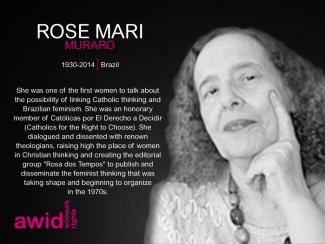
Rose Marie Muraro
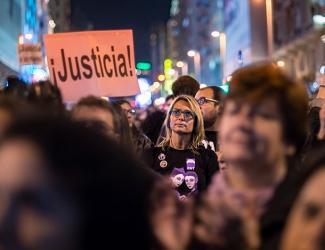
Across the globe, feminist, women’s rights and gender justice defenders are challenging the agendas of fascist and fundamentalist actors. These oppressive forces target women, persons who are non-conforming in their gender identity, expression and/or sexual orientation, and other oppressed communities.
Discriminatory ideologies are undermining and co-opting our human rights systems and standards, with the aim of making rights the preserve of only certain groups. In the face of this, the Advancing Universal Rights and Justice (AURJ) initiative promotes the universality of rights - the foundational principle that human rights belong to everyone, no matter who they are, without exception.
We create space for feminist, women’s rights and gender justice movements and allies to recognize, strategize and take collective action to counter the influence and impact of anti-rights actors. We also seek to advance women’s rights and feminist frameworks, norms and proposals, and to protect and promote the universality of rights.
Nicole Barakat is a queer femme, SWANA artist born and living on Gadigal Country (so-called Sydney, Australia). She works with deep listening and intuitive processes with intentions to transform the conditions of everyday life. Her work engages unconventional approaches to art-making, creating intricate works that embody the love and patience that characterises traditional textile practices.
As the world struggles with multiple intersecting crises, local communities and collectives of various kinds are resisting as also creating constructive alternatives.
📅 Wednesday, November 12, 2025
📍 Seminario Mar Nossa Sra Da Assunção, Pará, Brazil
A hands-on deckgame for collectives to explore feminist economic alternatives and systems of care as crisis response. This deckgame is for all movements navigating global climate crises through play and strategy based on real-life scenarios. A creative avenue to strategize in meetings, workshops, and community gatherings!
High-level panel discussion on the commemoration of the twenty-fifth anniversary of the adoption of the Durban Declaration and Programme of Action Concept note
Annual high-level panel discussion on human rights mainstreaming
Theme: Role of new and emerging digital technologies in preventing and eliminating female genital mutilation Concept note
Panel discussion on human rights and a culture of peace Concept note
Panel discussion on financing sustainable development in line with economic, social and cultural rights obligations. Concept note
Annual interactive debate on the rights of persons with disabilities
Theme: Disability-inclusive infrastructure, including transport and housing Concept note
Anual full-day meeting on the rights of the child Theme: Rights of the child and violations of the human rights of children in armed conflicts Concept note
📅 25 - 30 April
The program is a 4-part workshop series for local activists and feminists to learn about psychosocial support, harm reduction and self-defense, centering the lived realities of feminists from marginalized communities in Georgia; in order to prevent interpersonal violence and ultimately create inclusive, respectful and equal spaces for all.
For many of us, 2020 was an especially challenging year due to the global health pandemic. Feminists and activists rose to the new challenges meeting community needs in innovative ways. Here are 5 highlights of how AWID contributed to feminist co-creation and resistance.
Young feminist activists play a critical role in women’s rights organizations and movements worldwide by bringing up new issues that feminists face today. Their strength, creativity and adaptability are vital to the sustainability of feminist organizing.
At the same time, they face specific impediments to their activism such as limited access to funding and support, lack of capacity-building opportunities, and a significant increase of attacks on young women human rights defenders. This creates a lack of visibility that makes more difficult their inclusion and effective participation within women’s rights movements.
AWID’s young feminist activism program was created to make sure the voices of young women are heard and reflected in feminist discourse. We want to ensure that young feminists have better access to funding, capacity-building opportunities and international processes. In addition to supporting young feminists directly, we are also working with women’s rights activists of all ages on practical models and strategies for effective multigenerational organizing.
We want young feminist activists to play a role in decision-making affecting their rights by:
Fostering community and sharing information through the Young Feminist Wire. Recognizing the importance of online media for the work of young feminists, our team launched the Young Feminist Wire in May 2010 to share information, build capacity through online webinars and e-discussions, and encourage community building.
Researching and building knowledge on young feminist activism, to increase the visibility and impact of young feminist activism within and across women’s rights movements and other key actors such as donors.
Promoting more effective multigenerational organizing, exploring better ways to work together.
Supporting young feminists to engage in global development processes such as those within the United Nations
Collaboration across all of AWID’s priority areas, including the Forum, to ensure young feminists’ key contributions, perspectives, needs and activism are reflected in debates, policies and programs affecting them.
Sara AbuGhazal is a Palestinian feminist living in Beirut. She is a co-founder of Sawt al-Niswa, a collective that produces knowledge in Beirut. She is the co-director of The Knowledge Workshop, a feminist organization based in Beirut that works on feminist oral history and archiving. Sara is currently the Regional Coordinator of the Regional Coalition for Women Human Rights Defenders in the Middle East and North Africa.
Sara strives to help create spaces of feminist transformation and solidarity. Her work is mostly centered on building sustainable movements in the MENA region. She is invested in knowledge production, feminist transformation, and Palestine. She publishes regularly in sawtalniswa.org and her fiction also appears in Romman e-magazine.
Ȃurea Mouzinho is a feminist economic justice organizer from Luanda, Angola, with a 10-year career in research, grant-making, advocacy, and movement-building for women's rights and economic justice across Africa and the global south. Currently the Program Manager for Africa at Thousand Currents, she also serves on the Feminist Africa Editorial Board and is a member of Ondjango Feminista, a feminist collective she co-founded in 2016. A new mom to a Gemini boy, Ȃurea enjoys slow days with her young family and taking long strolls by the beach.
She occasionally tweets at @kitondowe.
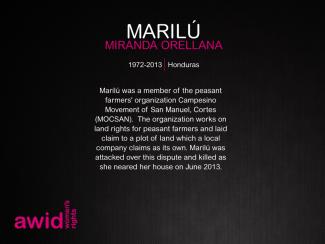
We work to achieve gender justice and women’s human rights by strengthening the collective voice, impact and influence of global women’s rights advocates, organizations and movements.

Informal interactive hearings with the business sector and civil society took place on 8 and 9 April 2015 respectively at UN headquarters in New York.
Please visit the "Funding ideas" page to get some ideas and inspiration for how you can fund your participation at the next Forum, including the limited support AWID will be able to provide.