Special Focus

AWID is an international, feminist, membership organisation committed to achieving gender equality, sustainable development and women’s human rights

Confronting Extractivism & Corporate Power

Women human rights defenders (WHRDs) worldwide defend their lands, livelihoods and communities from extractive industries and corporate power. They stand against powerful economic and political interests driving land theft, displacement of communities, loss of livelihoods, and environmental degradation.


Why resist extractive industries?

Extractivism is an economic and political model of development that commodifies nature and prioritizes profit over human rights and the environment. Rooted in colonial history, it reinforces social and economic inequalities locally and globally. Often, Black, rural and Indigenous women are the most affected by extractivism, and are largely excluded from decision-making. Defying these patriarchal and neo-colonial forces, women rise in defense of rights, lands, people and nature.

Critical risks and gender-specific violence

WHRDs confronting extractive industries experience a range of risks, threats and violations, including criminalization, stigmatization, violence and intimidation.  Their stories reveal a strong aspect of gendered and sexualized violence. Perpetrators include state and local authorities, corporations, police, military, paramilitary and private security forces, and at times their own communities.

Acting together

AWID and the Women Human Rights Defenders International Coalition (WHRD-IC) are pleased to announce “Women Human Rights Defenders Confronting Extractivism and Corporate Power”; a cross-regional research project documenting the lived experiences of WHRDs from Asia, Africa and Latin America.

We encourage activists, members of social movements, organized civil society, donors and policy makers to read and use these products for advocacy, education and inspiration.

Share your experience and questions!

Tell us how you are using the resources on WHRDs Confronting extractivism and corporate power.

◾️ How can these resources support your activism and advocacy?

◾️ What additional information or knowledge do you need to make the best use of these resources?

Share your feedback


Thank you!

AWID acknowledges with gratitude the invaluable input of every Woman Human Rights Defender who participated in this project. This project was made possible thanks to your willingness to generously and openly share your experiences and learnings. Your courage, creativity and resilience is an inspiration for us all. Thank you!

Related Content

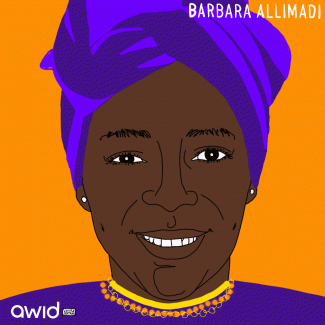
Barbara Allimadi

Barbara Allimadi was a political and human rights activist from Uganda. In 2012, she co-organized a protest against a televised police assault of Ingrid Turinawe, an opposition politician who had her breast squeezed by a police officer.

During the protest, Barbara, along with other fellow activists stripped to their bras in front of the Central Police Station in Kampala. This came to be known as the infamous ‘bra protest’ in Uganda.

“We settled on the bra protest. We thought it would be most appropriate for what had happened. It’s not like we were saying we don’t respect ourselves. We were disgusted by what had been done.” - Barbara Allimadi, 2013 (Daily Monitor)

With a Degree in Electronics and Communications Engineering from the London Metropolitan University, Barbara was a network engineer in the United Kingdom and an avid fan of reggae music. She returned to Uganda In 2007, when her mother passed away.

In 2019, she was appointed Coordinator for International and Diaspora Affairs at the Alliance for National Transformation (ANT), a political party launched that year by an opposition leader.

“We want security of life and property, not pain, injury and even death at the hands of security forces who are meant to protect us. Most importantly, we want a stable and enabling environment where we can realize our dreams and aspirations.” - Barbara Allimadi, ANT video

Barbara passed away on 27 April 2020. 


Tributes:

“I was so proud of my sister for many things but in particular her fearless pursuit of peace, democracy, justice and equality in Uganda. At the height of her activism she led many marches on the streets of Kampala, to police stations, and Parliament.” - Doris Allimadi, Barbara’s sister

“It is with deep sadness that we have learnt of the untimely passing of Barbara Allimadi. She has been a valiant, relentless and courageous force for the liberation movement of Uganda. Our deepest condolences to her family. She will be sorely missed.” - Akina Mama wa Afrika (tweet on 28 April 2020)

“The passing on of Barbara is so sad for us and her entire family. She dedicated herself to fighting for justice, freedom and rights of others while serving in the civil society until she recently joined us at the party.” Maj Gen Mugisha Muntu, ANT national coordinator

“A beautiful, charming, funny, charismatic and inspirational sister. My children lost their aunty. Uganda lost a brave and courageous freedom fighter. Barbara once said, ‘As long as there is still breath in you, keep working towards your dreams.’” - Doris Allimadi, Barbara’s sister

Snippet Kohl - Intro EN

TRANSNATIONAL EMBODIMENTS

Feminists have long asserted that the personal is political. Crear, Resister, Transform Festival created spaces for feminists to discuss issues around body, gender and sexualities, and explored the interconnections of how these issues are both deeply embodied experiences, and simultaneously a terrain where rights are constantly disputed and at risk in society.

The power of feminist movements lie in how we organise and take coordinated action, not only amongst our own communities and movements, but with allied social justice causes and groups. This space provided opportunities for movements to share and strengthen organizing and tactical strategies with each other.

The COVID-19 global health pandemic has made the failures of neo-liberal capitalism even more apparent than ever before, exposed the cracks in our systems, and highlighted the need and opportunities to build new realities. A feminist economic and social recovery requires all of us to make it together. This journal edition in partnership with Kohl: a Journal for Body and Gender Research, will explore feminist solutions, proposals and realities for transforming our current world, our bodies and our sexualities.

Explore the articles online or
Download PDF

Snippet - COP30 - Resistance Hubs Section Column 2 - EN

The following partners are organizing COP30 hubs:

  1. Caribbean Feminist Climate Justice Movement, Barbados
  2. Gender Interactive Alliance (GIA), Pakistan
  3. Women’s Initiative for Sustainable Environment (WISE), Nigeria
  4. Réseau des Acteurs du Développement Durable (RADD)*, Cameroon
  5. MASIPAG, The Phillippines

*Website in French

Conocimientos comunitarios para construir futuros justos

Contexto

En este momento, muchos sistemas de conocimientos comunitarios están en riesgo.

Los cambios vertiginosos que se dan a nivel económico, político y cultural están arrasando con ambientes, prácticas y medios de vida. Diversas formas de conocimiento están siendo borradas como prácticas, mercantilizadas y colonizadas por una globalización que se lo devora todo y a cambio de la promesa de logros en el corto plazo o paliativos.

Definición

El Buen Vivir /Vivir Bien, un concepto adaptado de los conocimientos de los pueblos indígenas andinos, se define como el logro colectivo de una vida en plenitud, basada en las relaciones armónicas y equilibradas entre los seres humanos y todos los seres vivientes, con reciprocidad y en complementariedad. Implica reconocer que los seres humanos formamos parte de la naturaleza, dependemos de ella y somos interdependientes entre nosotrxs.

Una visión que integra la producción y la reproducción como procesos inseparables de la economía, la producción de riqueza y las condiciones de vida es inherente al Buen Vivir / Vivir Bien.

Perspectiva feminista

Una mirada del Buen Vivir /Vivir Bien desde una óptica feminista valora las relaciones y los recursos que se movilizan en los ciclos de producción y reproducción — a favor de un equilibrio que no tiene que ver solo con el mercado — para garantizar la continuidad y los cambios siempre que sean compatibles con la justicia económica y la sostenibilidad de la vida.

Desde una perspectiva feminista también se ha criticado la concepción binaria del género y de la complementariedad entre hombres y mujeres en el Buen Vivir /Vivir Bien. Las concepciones binarias dejan poco espacio para un análisis más profundo del heteropatriarcado y de las relaciones de género disidentes.

Sin embargo, uno de los principales aportes que ofrece el principio del Buen Vivir / Vivir Bien cuando se le otorga un lugar central en los marcos de referencia políticos, económicos y sociales, es que la igualdad deja de ser el paradigma de los derechos individuales y su lugar pasa a ser ocupado por la transformación de la sociedad como un todo.


Para leer más acerca de esta propuesta:

CFA 2023 - Themes - EN

Themes

We welcome applications across the full range of thematic areas and intersections important to feminist and gender justice movements. In the application form, you will be able to mark more than one theme that fits your activity.

  • Free Bodies, Free Spirits: all things bodily autonomy, gender and sexuality, reproductive health and rights, freedom from gender-based violence, freedom to live in safety, pleasure and joy in our diverse bodies, identities and communities, and much, much more.
  • Resisting Anti-Rights: locally and globally, feminists are leading the way in resisting all forms of intersectional oppressions, including fascisms, fundamentalisms, and authoritarian regimes; we have a lot to share and strategize with each other about.
  • Movements and Organizing: let us get to know each other’s movements. From navigation of power (internal and external) to protection strategies in the face of the repression of women and gender-diverse human rights defenders, from alliance-building to creative and successful forms of organizing, let’s learn and be inspired by each other.
  • Economic Justice and Feminist Economies: this theme encompasses all feminist efforts to transform our economies, from challenging dominant extractive models and defending labor rights to embodying and living feminist economic practices and alternatives in everyday life.
  • Funding/Resourcing Activism: securing much-needed funding is a shared challenge for movements across the world; let us together unpack the feminist funding ecosystem, from critical analysis to first-hand experiences and practical ways to fund feminist work.
  • Climate, Environmental Justice, Land and Water: ecological and climate justice has deep roots in many of our movements and communities; from ancient traditions to futuristic visions, from ecology villages to campaigns to end extractivism and health justice, we invite a full scope of activities on all aspects of climate and environmental justice.
  • Militarization, War and Conflict: we aim to spotlight feminist organizing, analysis and experiences often on the frontline of crisis response and helping to sustain life, community and justice in the harshest times of war and protracted conflict.
  • Decolonization: decolonization is central to each and every one of our themes, yet it also stands on its own, as a key feminist agenda of resistance and world-building in many colonial and post-colonial realities.
  • Digital Realities and Feminist Tech: we welcome an opportunity to celebrate the incredible feminist initiatives that transform digital worlds, challenge big tech power structures, and democratize technology as truly by and for the people.
  • Healing Justice: there is an incredible diversity of approaches to collective care and healing justice. Worldwide, healers and movements are reclaiming healing justice as a political principle, a set of practices, a learning journey, a way of life, and much more.
  • Add your theme here!

Sexting Like a Feminist: Humor in the Digital Feminist Revolution Snippet Small

Sexting Like a Feminist: Humor in the Digital Feminist Revolution

by Chinelo Onwualu

On September 2nd, 2021, the amazing feminist and social justice activists of AWID’s Crear | Résister | Transform festival came together not only to share resistance strategies, co-create, and transform the world, but also to talk dirty on Twitter.


Read more


Snippet - COP30 - Deckgame card - EN

🎯 Deckgame: Organize. Strategize. Mobilize.

A hands-on deckgame for collectives to explore feminist economic alternatives and systems of care as crisis response. This deckgame is for all movements navigating global climate crises through play and strategy based on real-life scenarios. A creative avenue to strategize in meetings, workshops, and community gatherings!

Coming soon

Thank you to our partners

Our partners

This project is built in collaboration with:

FEMNET-logo (grey)
Rutgers-logo (grey)

Our contributors

We would also like to thank the following people for their valuable contribution:

  • Nebila Abdulmelik
  • Radhika Balakrishnan
  • Selamawit Tesfaye
  • Hakima Abbas
  • Patita Tingoi
  • Ana Abelenda

Clone of CFA 2023 - Hybrid like never before: in person - EN

In-person

Participants will come together in Bangkok, Thailand. We can’t wait!

#7 - Sexting like a feminist Tweets Snippet ES

¡Vente bien! Y muestra tus fuentes…

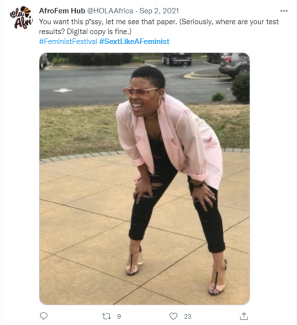
You want this pussy? Let me see that paper. (Seriously, where are your test results? Digital copy is fine.)

Si quieres esta concha, déjame ver ese papel (En serio, ¿dónde está el resultado de tu prueba? En versión digital está bien)

Snippet - COP30 Join thousands CTAs - FR

Rejoignez des milliers des personnes qui exigent une véritable justice climatique :

Suivez la campagne: 

Instagram| BlueSky

Rejoignez-nous

Devenir membre| Rejoignez notre communauté

Ne ratez rien des actualités

Abonnez-vous pour les actualités

Des questions ?
Contactez : communications @ awid.org

Graphismes basés sur des illustrations de Vectorarte.

Les principaux acteurs anti-droits

Nous constatons une implication sans précédent des acteurs anti-droits dans les espaces internationaux consacrés aux droits humains. Pour être plus efficaces et plus audibles, les acteurs anti-droits œuvrent à la constitution d’alliances tactiques qui regroupent différents secteurs et confessions et franchissent les frontières régionales et nationales.

Cette « alliance impie » entre des acteurs traditionalistes issus de milieux catholiques, évangéliques, mormons, orthodoxes russes et musulmans s’est construite autour d’une cause commune qui se concrétise dans un certain nombre de thèmes de discussion et d’efforts communs de plaidoyer visant à réduire à néant les progrès obtenus par les féministes en matière de droits sexuels au niveau international.


Le Saint-Siège

  • Activités clés : en tant que gouvernement de l’Église catholique romaine, le « Saint-Siège » utilise son statut unique d’État observateur permanent auprès de l’ONU pour faire pression en faveur de visions conservatrices, patriarcales et hétéronormatives de la féminité, de l’identité de genre et de la « famille ». Il promeut des politiques anti-avortement et anti-contraception.

  • Basé à : la Cité du Vatican, Rome, Italie.

  • Affiliation religieuse : catholique.

  • Connexions avec d’autres acteurs anti-droits : groupes chrétiens américains ; alliances interreligieuses orthodoxes ; OSC catholiques.

L’Organisation de la coopération islamique (OCI)

  • Activités clés : l’OCI se définit comme la « voix collective du monde musulman » et agit comme un bloc d’États au sein des Nations Unies. Elle tente d’ouvrir des brèches dans le système de protection des droits humains en s’appuyant sur des références à la religion, à la culture ou à la souveraineté nationale. Elle promeut le concept de « famille traditionnelle » et contribue à la mise en place d’un régime parallèle de droits humains doté d’un caractère plus restrictif (voir par exemple la Déclaration du Caire de 1990 sur les droits humains dans l’Islam).

  • Basé à : Djeddah, Arabie Saoudite.

  • Affiliation religieuse : musulmane.

  • Connexions à d’autres acteurs anti-droits : missions des États ultraconservateurs auprès de l’ONU, par exemple la Russie.

Le Congrès mondial des familles

  • Activités clés : conférences internationales et régionales ; production et diffusion de recherches et de connaissances ; lobbying auprès des Nations Unies pour « défendre la vie, la foi et la famille ».

  • Basé à : Rockford, Illinois, États-Unis.

  • Affiliation religieuse : prédominance catholique et chrétienne évangélique.

  • Connexions à d’autres acteurs anti-droits : le Sutherland Institute, un groupe de réflexion conservateur ; l’Église des Saints des Derniers Jours ; le département de la famille et de la vie de l’Église orthodoxe russe ; les prêtres catholiques anti-avortement et pro-vie ; la Fondation pour la culture et le patrimoine africains ; la Fédération polonaise des mouvements pro-vie ; la Fédération européenne des associations de familles catholiques ; le Comité des ONG de l’ONU sur la famille ; le Réseau politique pour les valeurs ; la Société démographique géorgienne ; des parlementaires polonais, moldaves, etc. ; FamilyPolicy ; l’Institut russe d’études stratégiques ; HatzeOir ; C-fam ; et d’autres encore.

Le Centre pour la famille et les droits de l’homme (C-Fam)

  • Activités clés : lobbying auprès des Nations Unies, en particulier auprès la Commission de la condition de la femme, pour la « défense de la vie et de la famille » ; diffusion d’informations diverses (par ex. les bulletins faxés du vendredi) ; travail de construction du mouvement ; formations à l’intention des militants conservateurs.

  • Basé à : New York et Washington D.C., États-Unis.

  • Affiliation religieuse : catholique.

  • Connexions avec d’autres acteurs anti-droits : l’International Youth Coalition (Coalition internationale de la jeunesse) ; l’Alliance mondiale pour la jeunesse ; Human Life International ; le Saint-Siège ; coordination de la Civil Society for the Family ; le Family Research Council (États-Unis) et d’autres OSC anti-droits chrétiennes/catholiques ; délégation des États-Unis auprès de la CSW.

Family Watch International

  • Activités clés : lobbying dans les espaces internationaux consacrés aux droits humains pour des politiques pro-famille, anti-LGBT*Q et anti-ESC (éducation sexuelle complète) ; formations à l’intention des acteurs de la société civile et des délégués d’États membres (par exemple « Le Guide des ressources sur la langue consensuelle des Nations Unies sur les questions familiales ») ; diffusion d’informations ; production de savoirs et d’analyses ; campagnes en ligne.

  • Basé à : Gilbert, Arizona, États-Unis.

  • Affiliation religieuse : Mormone.

  • Connexions avec d’autres acteurs anti-droits : en charge du Caucus sur les droits de la famille à l’ONU ; C-fam ; JONAH (Juifs offrant de nouvelles alternatives à l’homosexualité)[Béné1]  ; NARTH, l’Association nationale pour la recherche et la thérapie de l’homosexualité (USA) ; le Congrès mondial des familles ; CitizenGo ; l’Institut Magdalen ; l’Associación La Familia Importa ; le Groupe des amis de la famille (bloc de 25 États).

Alliance mondiale de la jeunesse

  • Activités clés : plaidoyer pour « la famille » et contre les droits sexuels et reproductifs dans les espaces politiques internationaux, y compris les Nations Unies, l’Union européenne et l’Organisation des États américains ; formation des jeunes membres à l’art de la diplomatie et de la négociation, aux relations internationales, aux activités de terrain et au développement d’une communication efficace ; programme de stage pour encourager la participation des jeunes aux activités de l’alliance ; conférences régulière des leaders émergents ; production et diffusion de savoirs.

  • Basé à : New York (États-Unis) avec des bureaux régionaux à Nairobi (Kenya), Quezon (Philippines), Bruxelles (Belgique), Mexico (Mexique) et Beyrouth (Liban).

  • Affiliation religieuse : principalement catholique, mais vise l’affiliation interreligieuse.

  • Connexions avec d’autres acteurs anti-droits : C-Fam ; Human Life International ; le Saint-Siège ; la campagne Life Coalition.

Église orthodoxe russe

  • Activités clés : l’Église orthodoxe russe, en capitalisant sur ses liens étroits avec l’État russe, fonctionne comme un « entrepreneur de normes » dans le cadre des débats sur les droits humains. La Russie et l’Église orthodoxe russe ont coopté le langage des droits humains pour souligner l’importance de la « moralité » et des « valeurs traditionnelles » définies comme des fondements prétendument essentiels des droits humains. La Russie a mené une série d’actions pour que le Conseil de l’Europe adopte des résolutions fondées sur les « valeurs traditionnelles » et a été en première ligne du travail visant à proposer des amendements hostiles aux résolutions progressistes dans des domaines tels que la mortalité maternelle, la protection du champ d’action de la société civile et le droit de manifester pacifiquement.

  • Connexions avec d’autres acteurs anti-droits : Organisation de la coopération islamique ; Églises orthodoxes d’Europe de l’Est et du Caucase, par ex. l’Église orthodoxe géorgienne ; la droite chrétienne américaine, y compris les évangéliques américains ; le Congrès mondial des familles ; le Groupe des amis de la famille (bloc d’États).
Main image
FFC - Banners.png
Body

Club de Cine Feminista

Como parte del Viaje por las Realidades Feministas de AWID, te invitamos a explorar nuestro nuevo Club de Cine Feminista: una colección de cortometrajes y largometrajes seleccionados por nuestrxs curadorxs y narradorxs feministas de todo el mundo, que incluyen a Jess X. Snow (Asia-Pacífico), Gabrielle Tesfaye (África/Diáspora Africana) y Esra Ozban (Sudoeste Asiático y África del Norte). Alejandra Laprea es la curadora del programa de América Latina y Centroamérica, que inauguraremos en septiembre, durante el evento de AWID Crear, Résister, Transform: un festival para movimientos feministas. Mientras tanto, ¡mantente atentx a los anuncios sobre proyecciones especiales y conversaciones con cineastas!

CFA 2023 - Hubs - thai

ใหม่

จุดศูนย์กลาง: การเดินทางข้ามพรมแดน

ผู้เข้าร่วมประชุมจะได้เข้าร่วมตามสถานที่ต่างๆนอกเพื้นที่ในการจัดงานที่กรุงเทพฯ  และตามส่วนต่างๆของ โลกในแต่ละวันของการประชุม สถานที่ประชุมที่ผู้เข้าร่วมจัดการเองทั้งหมดนั้นจะเชื่อมต่อกับสถานที่จัดงาน
จริงในกรุงเทพฯเช่นเดียวกับบุคคลที่เชื่อมต่อทางออนไลน์        ผู้เข้าร่วมในจุดศูนย์กลาง Hub นี้จะสามารถ ดำเนินรายการในหัวข้อกิจกรรมต่างๆ เข้าร่วมอภิปราย แลกเปลี่ยน และเพลิดเพลินไปกับโปรแกรม ที่หลากหลาย

ที่ตั้งจุดศูนย์กลาง Hub จะประกาศในปี 2567

#2 - Sexting like a feminist Tweets Snippet FR

Un indice visuel est toujours utile

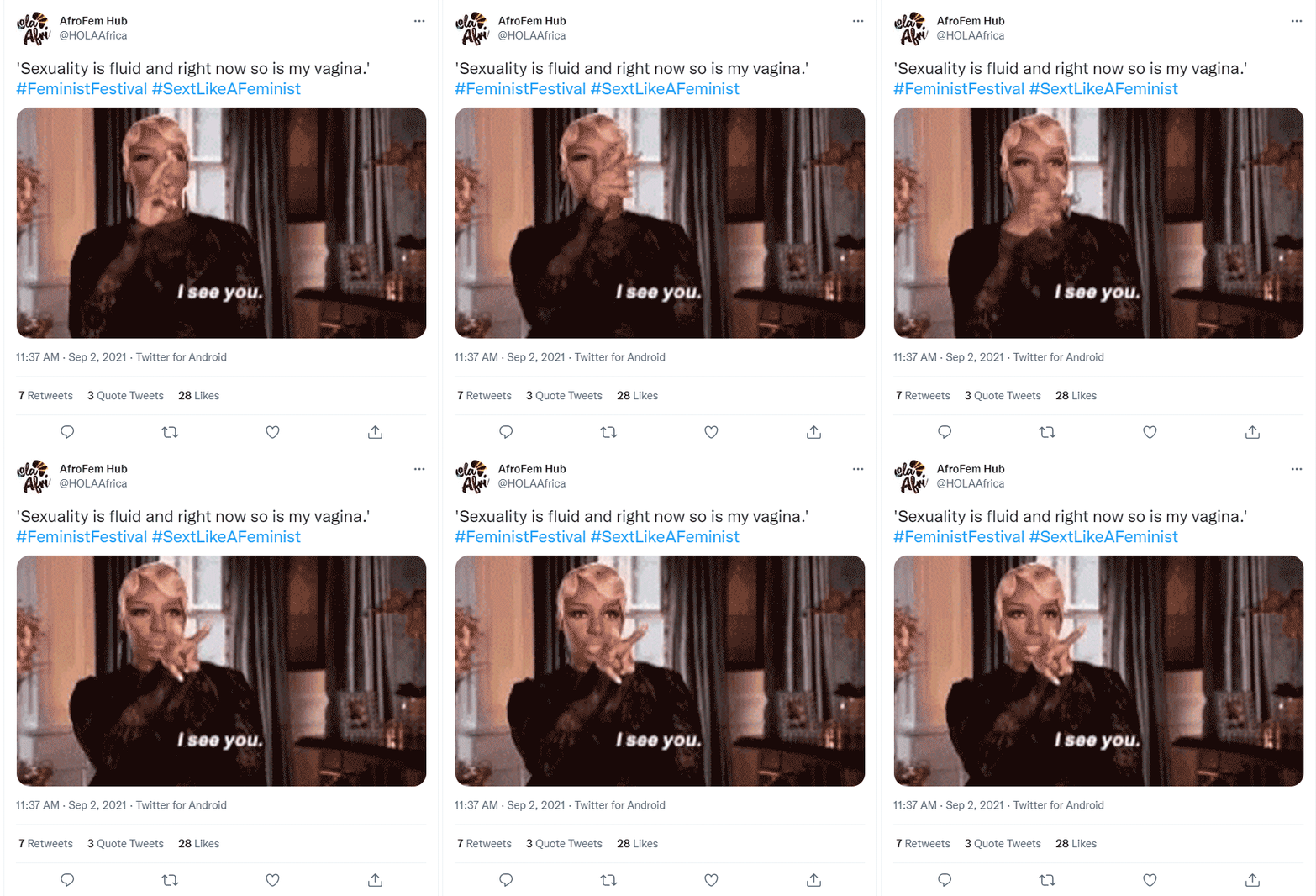
« La sexualité est fluide, et là mon vagin aussi. »
#FeministFestival #SextLikeAFeminist