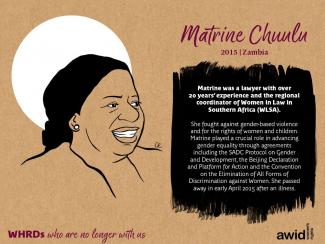
Matrine Chuulu
WHRDs are self-identified women and lesbian, bisexual, transgender, queer and intersex (LBTQI) people and others who defend rights and are subject to gender-specific risks and threats due to their human rights work and/or as a direct consequence of their gender identity or sexual orientation.
WHRDs are subject to systematic violence and discrimination due to their identities and unyielding struggles for rights, equality and justice.
The WHRD Program collaborates with international and regional partners as well as the AWID membership to raise awareness about these risks and threats, advocate for feminist and holistic measures of protection and safety, and actively promote a culture of self-care and collective well being in our movements.
WHRDs are exposed to the same types of risks that all other defenders who defend human rights, communities, and the environment face. However, they are also exposed to gender-based violence and gender-specific risks because they challenge existing gender norms within their communities and societies.
We work collaboratively with international and regional networks and our membership
We aim to contribute to a safer world for WHRDs, their families and communities. We believe that action for rights and justice should not put WHRDs at risk; it should be appreciated and celebrated.
Promoting collaboration and coordination among human rights and women’s rights organizations at the international level to strengthen responses concerning safety and wellbeing of WHRDs.
Supporting regional networks of WHRDs and their organizations, such as the Mesoamerican Initiative for WHRDs and the WHRD Middle East and North Africa Coalition, in promoting and strengthening collective action for protection - emphasizing the establishment of solidarity and protection networks, the promotion of self-care, and advocacy and mobilization for the safety of WHRDs;
Increasing the visibility and recognition of WHRDs and their struggles, as well as the risks that they encounter by documenting the attacks that they face, and researching, producing, and disseminating information on their struggles, strategies, and challenges:
Mobilizing urgent responses of international solidarity for WHRDs at risk through our international and regional networks, and our active membership.
جلسة عامة | التنظيم لتحقيق النصر
مع نازك أبيلجازيفا وأمارانتا جوميز ريجالادو وسيندي ويزنر ولوسينيا فريتا
1 |
Fournir aux membres de l’AWID, partenaires du mouvement et financeurs une analyse actualisée, robuste, éprouvée et orientée sur l’action des réalités du financement des mouvements féministes et de l’état actuel de l’écosystème du financement féministe. |
2 |
Identifier et expliquer les occasions d’orienter davantage de financement de meilleure qualité vers l’organisation des mouvements féministes, mettre en lumière les fausses solutions et mettre un frein aux tendances à cause desquelles les financements ne parviennent pas et/ou vont à l’encontre des programmes de justice de genre et féministes intersectionnels. |
3 |
Formuler les visions, propositions et programmes féministes en faveur de la justice du financement. |
يتبيّن من هذه التويتات الفكاهة المقرونة بالإثارة والاهتياج الجنسيّ، التي تتّسم بها المقاربة النسوية لكتابة الرسائل ذات المضامين الجنسية، دون أن تُسقط عن نفسها الالتزام بالمساواة والعدالة.
Votre participation à l’enquête WITM est importante à plusieurs égards. Vous aurez, notamment, l’occasion de faire part de votre expérience vécue de la mobilisation de fonds pour soutenir votre organisation, de réclamer votre autorité en tant qu’experte sur la manière dont l’argent est transféré et qui il atteint réellement, et de contribuer à un plaidoyer collectif et cohérent auprès de financeurs afin que les fonds circulent davantage et soient de meilleure qualité. Au cours des deux dernières décennies, la recherche WITM de l’AWID s’est révélée être une ressource clé pour les activistes et les financeurs. Nous vous invitons chaleureusement à participer à sa troisième édition pour souligner la situation actuelle des ressources, remettre en question les fausses solutions, et identifier les modifications nécessaires dans le financement afin que les mouvements s’épanouissent et relèvent les défis complexes de notre époque.
L'exposition #MeToo en Chine a été organisée pour la première fois en 2019 et a effectué une tournée dans 5 villes. L'objectif de l'exposition est de mettre davantage en avant les expériences personnelles des victimes et des activistes et, en prenant part à ces histoires, d'inspirer notre public à se joindre à la lutte. L'exposition est elle-même devenue une partie de la lutte #MeToo; elle a fait face à d’innombrables défis lors de sa tournée à travers la Chine et a même risqué la fermeture à plus d'une occasion.
Yes! We recognize and appreciate different reasons why feminists, in their respective contexts, don’t have external funding: from being ineligible to apply for grants and/or receive money from abroad, to relying on resources generated autonomously as a political strategy in its own right. We want to hear from you regardless of your experience with external funding.
Nicole Barakat is a queer femme, SWANA artist born and living on Gadigal Country (so-called Sydney, Australia). She works with deep listening and intuitive processes with intentions to transform the conditions of everyday life. Her work engages unconventional approaches to art-making, creating intricate works that embody the love and patience that characterises traditional textile practices.
Por el momento, la encuesta en KOBO está disponible en árabe, español, francés, inglés, portugués y ruso. Tendrás oportunidad de seleccionar el idioma de preferencia al inicio de la encuesta.

Este proyecto se desarrolla en colaboración con:
L’enquête WITM portant sur les réalités du financement des organisations féministes, la plupart des questions traitent du financement de votre groupe entre 2021 et 2023. Vous aurez besoin de disposer de ces informations pendant que vous répondez aux questions de l’enquête (vos budgets annuels et principales sources de financement, par exemple)