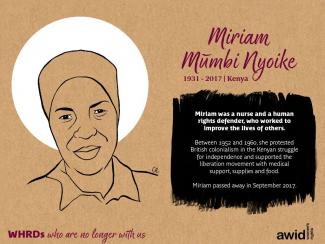
Miriam Mũmbi Nyoike
Women human rights defenders (WHRDs) worldwide defend their lands, livelihoods and communities from extractive industries and corporate power. They stand against powerful economic and political interests driving land theft, displacement of communities, loss of livelihoods, and environmental degradation.
Extractivism is an economic and political model of development that commodifies nature and prioritizes profit over human rights and the environment. Rooted in colonial history, it reinforces social and economic inequalities locally and globally. Often, Black, rural and Indigenous women are the most affected by extractivism, and are largely excluded from decision-making. Defying these patriarchal and neo-colonial forces, women rise in defense of rights, lands, people and nature.
WHRDs confronting extractive industries experience a range of risks, threats and violations, including criminalization, stigmatization, violence and intimidation. Their stories reveal a strong aspect of gendered and sexualized violence. Perpetrators include state and local authorities, corporations, police, military, paramilitary and private security forces, and at times their own communities.
AWID and the Women Human Rights Defenders International Coalition (WHRD-IC) are pleased to announce “Women Human Rights Defenders Confronting Extractivism and Corporate Power”; a cross-regional research project documenting the lived experiences of WHRDs from Asia, Africa and Latin America.
"Women Human Rights Defenders confronting extractive industries: an overview of critical risks and Human Rights obligations" is a policy report with a gender perspective. It analyses forms of violations and types of perpetrators, quotes relevant human rights obligations and includes policy recommendations to states, corporations, civil society and donors.
"Weaving resistance through action: Strategies of Women Human Rights Defenders confronting extractive industries" is a practical guide outlining creative and deliberate forms of action, successful tactics and inspiring stories of resistance.
The video “Defending people and planet: Women confronting extractive industries” puts courageous WHRDs from Africa, Asia, and Latin America in the spotlight. They share their struggles for land and life, and speak to the risks and challenges they face in their activism.
Challenging corporate power: Struggles for women’s rights, economic and gender justice is a research paper outlining the impacts of corporate power and offering insights into strategies of resistance.
AWID acknowledges with gratitude the invaluable input of every Woman Human Rights Defender who participated in this project. This project was made possible thanks to your willingness to generously and openly share your experiences and learnings. Your courage, creativity and resilience is an inspiration for us all. Thank you!
Si deseas guardar las respuestas y retomar la encuesta más tarde, puedes hacerlo todas las veces que lo necesites. KOBO guardará tus respuestas en la esquina superior izquierda de la página de la encuesta y recargará tu registro cuando regreses a la encuesta. Solo asegúrate de continuar desde la misma computadora y navegador.
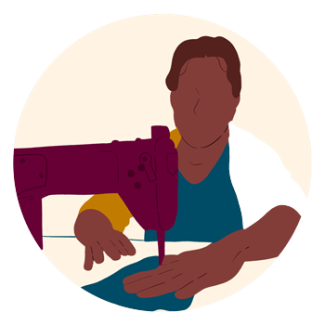
EL CUPO LABORAL TRANS
no está siendo respetado por las empresas
Si, quelle qu’en soit la raison, vous souhaitez que votre participation soit annulée et vos réponses supprimées, vous en avez le droit. Merci de nous contacter par le biais de ce formulaire, en indiquant « Enquête WITM (Où est l’argent?) » dans l’objet de votre message. Nous annulerons votre participation et supprimerons vos réponses.
« Mes rêves et mes objectifs ont toujours été les mêmes que ceux de Lohana Berkins : que la coopérative continue à exister et non à fermer. Continuez à offrir cet endroit à nos collègues travesti, à leur donner du travail et un lieu de soutien»
Brisa Escobar,
présidente de la Coopérative
If you have any questions or concerns, please contact us via the form here, indicating “WITM Survey” as the title of your message. You can also write to us at witm@awid.org.
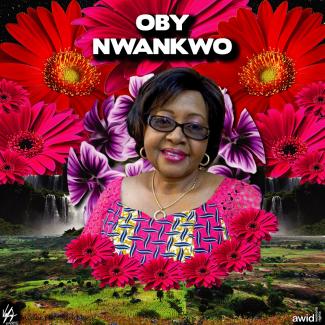
Avec une carrière juridique de plus de 30 ans à son actif, Oby était connue en Afrique et dans le monde comme une ardente défenseure de la justice de genre et des droits humains.
Elle a fondé le Centre de documentation et de développement des ressources civiles (CIRDDOC), une ONG nigériane qui sponsorise des formations et des activités de mise en réseau qui promeuvent les droits humains, la bonne gouvernance, l’accès à la justice et l’État de droit pour les membres de la société civile, les parlementaires, ainsi que d’autres parties prenantes concernées.
Au Nigeria, les activistes se souviennent d’Oby avec émotion, la qualifiant « d’activiste extraordinaire qui a fait preuve d’énergie et de passion pour lutter pour l’égalité de genre et la justice de genre au Nigéria et en Afrique »

Para partilhar a sua experiência vivida com o financiamento da sua organização;
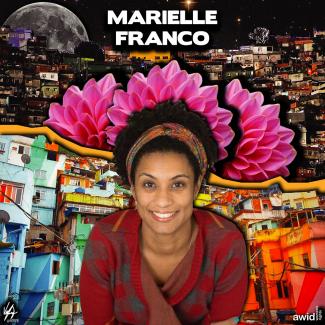
Marielle was a Brazilian politician, feminist, lesbian and human rights activist.
Marielle was an outspoken critic of police brutality and extrajudicial killings. Her openly feminist, Black and favela-centered politics were a source of hope for marginalized groups in Rio de Janeiro, currently governed by a conservative city government and an evangelical mayor.
On March 14, 2018, after delivering a speech in Rio de Janeiro, Franco and her driver were shot multiple times and killed. Following news of her death crowds took to the streets shouting "Marielle presente!" (Marielle is here!) and demanding justice be done.
Read more about Marielle and the situation in Brazil
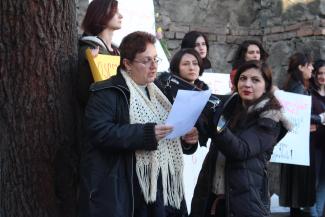

Феминистские движения, движения за права женщин, гендерную справедливость, ЛГБТКИ+ и смежные движения по всему миру переживают критический момент, сталкиваясь с мощной негативной реакцией на ранее завоеванные права и свободы. Последние годы привели к быстрому росту авторитаризма, жестоким репрессиям в отношении гражданского общества и криминализации правозащитниц(-ков) с разнообразной гендерной самоидентификацией, эскалации войн и конфликтов во многих частях света, продолжающейся экономической несправедливости, – и все это на фоне кризиса в области здравоохранения, экологии и климата.
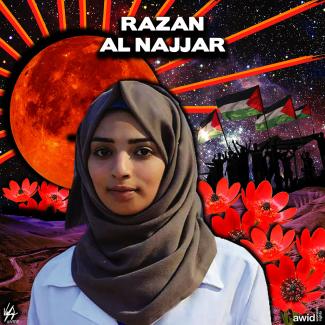
Razan era una médica voluntaria de 21 años en Palestina.
Le dispararon cuando corría hacia un muro fronterizo fortificado, en un intento por llegar hasta una persona herida en el este de la ciudad de Khan Younis, en el sur de Gaza.
En su última publicación en Facebook, Razan dijo: «Estoy volviendo y no retirándome», y añadió: «Denme con sus balas, no tengo miedo».
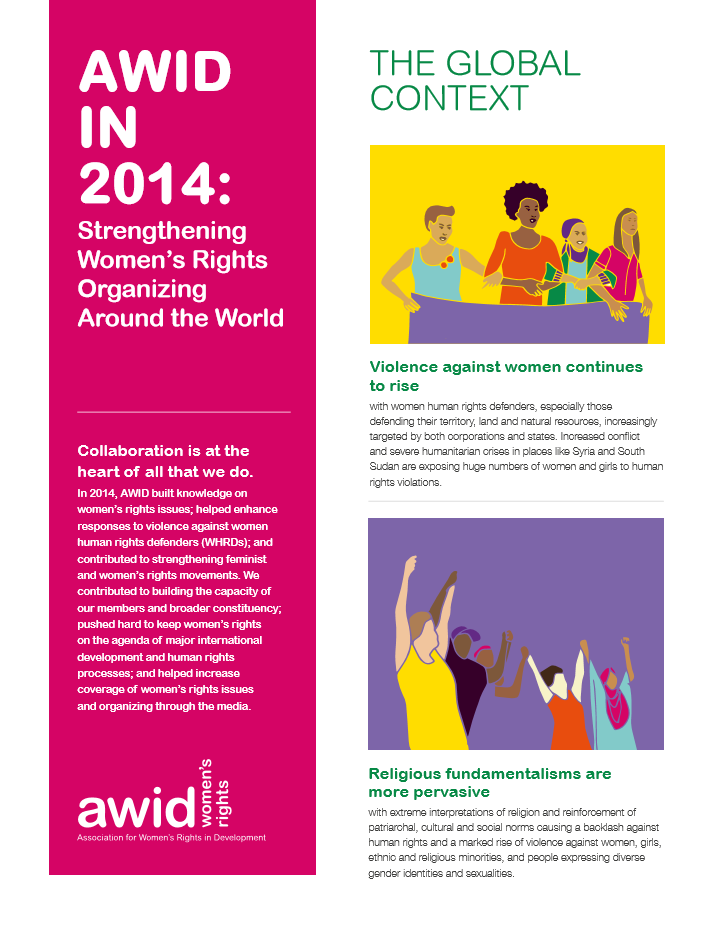
AWID is very pleased to share our 2014 Annual Report.
From building knowledge on women’s rights issues to amplifying responses to violence against women human rights defenders (WHRDs), our work last year continued to strengthen feminist and women’s rights movements across the world.
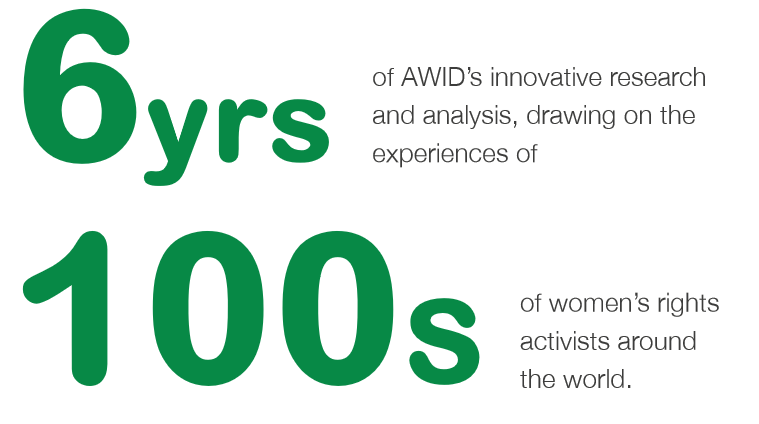
Get learn how we built the capacity of our members and broader constituency, pushed hard to keep women’s rights on the agenda of major international development and human rights processes, and helped increase coverage of women’s rights issues and organizing through the media. You'll find a panoramic sampling of our projects and some concrete numbers demonstrating our impact.
Collaboration is at the heart of all that we do, and we look forward to another year of working together to take our movements to the next level.
Despite an increasingly challenging panorama, there are important signs of hope for advancing women’s rights agendas. Women’s rights activists remain crucial in creating openings to demand structural change, sustaining their communities, opposing violence and holding the line on key achievements. And there are important opportunities to influence new actors and to mobilize greater resources to support women’s rights organizations.
In this context, strong collective action and organizing among women’s rights activists remains essential.
I am sincerely thrilled by AWID’s accomplishments since 1982 and hope to be able to pay at least a modest contribution to its hard work for the benefit of women and situation of gender equality.” — Aleksandra Miletic-Santic, Bosnia Herzegovina