Organizing creatively, facing an increasing threat
Young feminist activists play a critical role in women’s rights organizations and movements worldwide by bringing up new issues that feminists face today. Their strength, creativity and adaptability are vital to the sustainability of feminist organizing.
At the same time, they face specific impediments to their activism such as limited access to funding and support, lack of capacity-building opportunities, and a significant increase of attacks on young women human rights defenders. This creates a lack of visibility that makes more difficult their inclusion and effective participation within women’s rights movements.
A multigenerational approach
AWID’s young feminist activism program was created to make sure the voices of young women are heard and reflected in feminist discourse. We want to ensure that young feminists have better access to funding, capacity-building opportunities and international processes. In addition to supporting young feminists directly, we are also working with women’s rights activists of all ages on practical models and strategies for effective multigenerational organizing.
Our Actions
We want young feminist activists to play a role in decision-making affecting their rights by:
Fostering community and sharing information through the Young Feminist Wire. Recognizing the importance of online media for the work of young feminists, our team launched the Young Feminist Wire in May 2010 to share information, build capacity through online webinars and e-discussions, and encourage community building.
Researching and building knowledge on young feminist activism, to increase the visibility and impact of young feminist activism within and across women’s rights movements and other key actors such as donors.
Promoting more effective multigenerational organizing, exploring better ways to work together.
Supporting young feminists to engage in global development processes such as those within the United Nations
Collaboration across all of AWID’s priority areas, including the Forum, to ensure young feminists’ key contributions, perspectives, needs and activism are reflected in debates, policies and programs affecting them.
Related Content
Por que devo considerar responder ao inquérito?
Existem várias razões pelas quais a sua resposta ao inquérito WITM é importante. Por exemplo, tem a oportunidade de partilhar a sua experiência vivida com a mobilização de financiamento para apoiar a sua organização; de reivindicar o seu poder como especialista sobre como o dinheiro circula e os bolsos em que entra; e de contribuir para a defesa coletiva e consistente junto de financiadores para mover mais recursos de maior qualidade. Ao longo das últimas duas décadas, o inquérito WITM da AWID tem-se revelado um recurso fundamental para ativistas e financiadores. Convidamo-lo a juntar-se a nós na sua terceira edição para destacar o estado efetivo do financiamento, desafiar soluções falsas e apontar a forma como o financiamento precisa de mudar para que os movimentos prosperem e enfrentem os desafios complexos do nosso tempo.
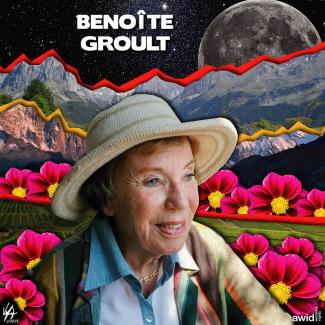
Benoîte fue una periodista, escritora y activista feminista francesa.
Benoîte publicó más de 20 novelas y numerosos ensayos sobre feminismo.
En 1975 se publicó su primer libro, Ainsi Soit-Elle (que podría traducirse «Como ella es»). En él analizaba la historia de los derechos de las mujeres, así como la misoginia y la violencia contra las mujeres.
En su último libro, Ainsi Soit Olympe de Gouges, analizaba los derechos de las mujeres durante la Revolución Francesa, centrándose en la pionera feminista francesa. Olympe de Gouges fue guillotinada en 1793 por desafiar la autoridad masculina; dos años antes había publicado una declaración sobre los derechos de las mujeres («Déclaration Des droits de la Femme et de la Citoyenne»).
Snippet FEA Unfair Policies (ES)
POLÍTICAS INJUSTAS
Our arepa: Resistance from the Kitchen
by Alejandra Laprea, Caracas, Venezuela (@alejalaprea)
I live in a country of the impossible, where there are no bombs yet we are living in a war.
A war that exists only for those of us living in this territory.
I live in a country no one understands, which few can really see, where various realities co-exist, and where the truth is murdered time and again.
I live in a country where one has to pay for the audacity of thinking for oneself, for taking on the challenge of seeing life another way.
I live in a country of women who have had to invent and reinvent, time and again, how they live and how to get by.
I live in Venezuela, in a time of an unusual and extraordinary threat.
Since 2012 my country has been subjected to an unconventional war. There are no defined armies or fire power. Their objective is to dislocate and distort the economy, affecting all households, daily life, the capacity of a people to dream and build a different kind of politics, an alternative to the patriarchal, bourgeois, capitalist democracy.
Venezuelan women are the primary victims of this economic war. Women who historically and culturally are responsible for providing care, are the most affected and in demand. However, in these years of economic and financial embargo, Venezuelan women have gone from being victims to the protagonists on the front lines defending our territory.
Battles are fought from the barrios, kitchens, and small gardens. We defend the right of girls and boys to go to school, and to be given something so simple as some arepas for breakfast.
Arepas are a kind of corn cake that can be fried, roasted or baked and served sweet or savoury as a side or main dish. It is a staple in the diet of all Venezuelans.
In Venezuela, arepas mean culture, family, food sovereignty, childhood nostalgia, the expert hands of grandmothers molding little balls, the warmth that comforts you when recovering from illness.
Arepas connect us as a people with the pre-Colombian cultures of corn, a resistance that has endured for more than five centuries. They are the Caribbean expressed differently on firm ground.
They are an act of resistance.
When my mother was a girl, they would start grinding the dry corn early in the morning to make arepas. The women would get up and put the kernels of corn in wooden mortars and pound it with heavy mallets to separate the shells. Then they would boil, soak, and grind the corn to make dough, and finally they would mold it into round arepas. The process would take hours and demand a lot of physical effort.
In the mid-20th century a Venezuelan company industrialized the production of corn meal. For an entire generation that seemed like an act of liberation, since there was now a flour that you could simply add water to and have hot arepas in 45 minutes time.
But that also meant that the same generation would lose the traditional knowledge on how to make them from scratch. My grandmother was an expert arepa maker, my mother saw it as a girl, and for me the corn meal came pre-packaged.
In the war with no military, the pre-cooked corn meal came to be wielded as an instrument of war by the same company that invented it, which was not so Venezuelan anymore: today the Polar group of companies is transnational.
We women began to recuperate our knowledge by talking with the eldest among us. We searched in the back of the closets for our grandmothers’ grinders, the ones we hadn’t thrown away out of affection. Some families still prepared the corn in the traditional way for important occasions. In some towns there were still communal grinding stations which had been preserved as part of local history or because small family businesses refused to die. All of these forms of cultural resistance were activated, and we even went so far as to invent new arepas.
Today we know that in order to resist we cannot depend on one food staple. Although corn arepas continue to be everyone’s favourite, we have invented recipes for arepas made of sweet potato, cassava, squash, and celery root.
We have learned that we can use almost any root vegetable to make arepas. Cooperative businesses have developed semi-industrial processes to make pre-cooked corn meal. In other words, we have recuperated our arepas and their preparation as a cultural good that belongs to all.
My artivism aims to decolonize our senses in everyday life. I like to create spaces that communicate how we weave together our different struggles, and that render visible dissident (re)existences, other possible worlds, and living bodies here in the SOUTH.
As we continue to fight in our struggles, let us remember how essential it is that we support each other, believe each other, and love ourselves and our sisters. When this system fucks us over, we must take time to look after our (physical and mental) health, that of our sisters, and to understand that each one of us carries unique stories, making us fighters in resist
Marga RH (@Marga.RH)
Until dignity becomes a habit
These portraits are inspired by the voices of resistance and protest movements in Latin America, especially by the key role that feminised bodies play in these struggles. It is a tribute to the grassroots feminist movements in resistance.
Become a member - Spanish (homepage block)
Afíliate
Al unirte a AWID, te sumas a un proceso organizativo feminista mundial, un poder colectivo surgido del trabajo entre movimientos y basado en la solidaridad.
Elina is a young afro-Dominican intersectional feminist and human rights lawyer, committed to use her voice and skills to build a more just, empathic and inclusive world. She started Law school at 16, convinced it would give her the tools to understand and promote social justice. After a J.D. in the Dominican Republic, she pursued an LL.M. in Public International Law and Human Rights in the UK as a Chevening Scholar. She was the only Latinx-Caribbean woman in her class, graduating with honours.
Elina has worked at the intersection of human rights, gender, migration and policy, from government, grassroots collectives and international organizations. She helped litigate cases on gender-based violence before the Inter-American Court of Human Rights. As a member of the Youth Advisory Panel of UNFPA, she contributed to strengthening sexual and reproductive rights in the Dominican Republic. She co-led Amnesty International’s first campaign on sex workers’ rights in the Americas, developing strong partnerships with sex-worker led organizations and using Amnesty’s position to amplify women human rights defenders and sex workers’ voices.
Elina is part of Foro Feminista Magaly Pineda and the Global Shapers Community. She speaks Spanish, French and English. Thanks to her diverse background, Elina brings strong governance and strategic planning skills, substantive expertise on the United Nations and regional human rights mechanisms and her bold determination to keep AWID as an inclusive organization for all women, especially young and Caribbean feminists. With these offerings, joins a global sisterhood of feminist badasses, where she can keep nurturing her feminist leadership and never again feel alone in her path.
نحن نعيد إعطاء المال لشركائنا/شريكاتنا ونعرّف عن أنفسنا كنسويات و\ أو صندوق نسائي. هل علينا تعبئة الاستطلاع؟
كلا. نقدّر عملكم/ن لكننا لا نطلب في هذه المرحلة من الصناديق النسوية والنسائية تعبئة الاستطلاع. نشجعكم/ن على مشاركة الاستطلاع مع شركائكم/ن و شبكاتكم/ن النسوية.
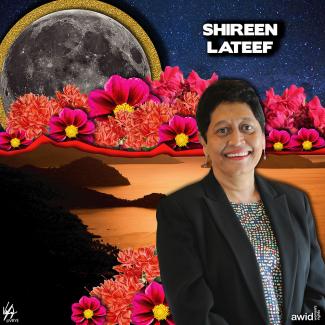
Figure inspirante pour de nombreux-ses féministes aux Fidji, Shireen était une alliée de poids du mouvement des femmes. Elle a plaidé sans relâche pour l'égalité de genre aux niveaux local et régional.
Ayant débuté sa carrière en tant que spécialiste de l’égalité de genre à la Banque asiatique de développement, elle a apporté des changements radicaux en matière d’égalité de genre aux politiques de l’institution. Sa recherche, intitulée « La règle des Danda : la violence domestique chez les Indo-Fidjiens », est l'une des premières recherches sur la violence domestique, le mariage et les femmes aux Fidji. Ce travail précurseur a servi de catalyseur pour la militance féministe dans ce domaine.
L’héritage de Shireen lui survit et beaucoup se souviennent de son influence, de son engagement et de son soutien au mouvement des femmes aux Fidji et dans le Pacifique.
Snippet FEA Sopo Japaridze (FR)
Nous avons le plaisir de vous présenter Sopo Japaridze, féministe féroce, dirigeante syndicale et présidente du syndicat de service indépendant Réseau de Solidarité.
Elle a quitté le pays très jeune pour les États-Unis, où elle est devenue politiquement active en tant qu'organisatrice syndicale. Elle a toujours gardé la Géorgie à l'esprit pendant tout ce temps, jusqu'au jour où, 20 ans plus tard, elle a décidé de revenir.
La confédération syndicale géorgienne existante à cette époque était loin d'être idéale. C’est pourquoi, armée de ses compétences, de ses connaissances et de son expérience en matière de syndicalisation, Sopo est retournée en Géorgie et a formé son propre syndicat.
Elle est aussi une chercheuse passionnée et une écrivaine. Elle étudie les relations de travail et les relations sociales, écrit pour diverses publications et est co-éditrice de Left East, une plate-forme analytique d'Europe de l'Est. Elle a également cofondé l'initiative et le podcast d'histoire politique, Réimaginer la Géorgie Soviétique, où elle explore les complexités et les nuances des expériences du pays sous l'Union soviétique, pour mieux comprendre son passé et construire un avenir meilleur.
Exposición en el Jardín de los Placeres
Estas obras son un trabajo colaborativo de fotografías e ilustraciones realizadas por Siphumeze y Katia durante el confinamiento. Muestran narrativas negras queer de sexo y placer, bondage, sexo seguro, juguetes, salud mental y sexo, y mucho más. Fueron creadas para acompañar la antología Touch.
“Mental Health” [«Salud mental»]“Sex and Spirituality” [«Sexo y espiritualidad»]“Orgasm” [«Orgasmo»]
About the Artists:
Siphumeze Khundayi es una creadora de arte, fotógrafa y facilitadora interesada en las formas creativas de unir el diálogo y la práctica artística en relación con la identidad queer africana.
Es directora creativa de HOLAAfrica!, una colectiva en línea mujerista panafricanista.
Sus trabajos de performance individual y en colaboración han sido presentados en numerosos festivales y espacios teatrales, tales como el Ricca Ricca Festival de Japón.
En 2017 y 2018 dirigió dos producciones que fueron nominadas a los Naledi Theatre Awards y, en 2020, obtuvo un premio Standard Bank Ovation.
Como fotógrafa, participó en Italia en una exposición grupal titulada Flowers of my Soul, organizada por The Misfit Project. Produjo tres publicaciones para HOLAAfrica!, y sus trabajos fueron publicados dentro y como tapa del Volume Two: As You Like de las Gerald Kraak Anthologies.
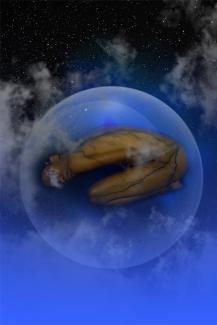
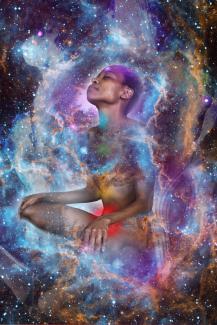
Katia Herrera es una artista visual digital de 21 años, de la ruidosa ciudad de Santo Domingo, en la República Dominicana. A pesar de que se autodefine como introvertida, su obra es notablemente estruendosa en un mundo que intenta acallar las voces negras. Con títulos como “Black Woman” [«Mujer Negra»], “You Own the Moon” [«La Luna es Tuya»], “Earth Goddess” [«Diosa de la Tierra»], “Forever” [«Por Siempre»] y “Universe Protector” [«Protectora del Universo»], el legado de Herrera estará marcado por su pasión por poner de manifiesto la resistencia y la perseverancia de las personas negras del pasado y del presente, en contraposición a la narrativa de que la piel negra debería solamente ser asociada con la esclavitud.
Una de sus obras más hermosas y vivazmente tituladas, “Universe Protector”, representa al alma negra como una entidad divina plena de fortaleza, poder y grandeza. En su juventud, su amor por el diseño gráfico se vio estimulado por el talento artístico de su madre y su padre, y por el programa Photoshop que habían descargado en su computadora para su trabajo profesional de fotografía.
Reason to join 4
Voyez grand ! Notre rayonnement international nous permet de combiner notre travail analytique avec des outils politiques et pratiques de plaidoyer et de transformation afin de faire avancer la cause des mouvements féministes à tous les niveaux.
María es diseñadora gráfica y comunicadora visual. Ha trabajado con ONG e instituciones por los derechos humanos como Profamilia y OXFAM. Como mujer del Sur Global, se siente especialmente atraída a usar sus competencias para trabajar con organizaciones que ayudan a proteger el bienestar, así como los derechos de millones de niñas y mujeres de América Latina.
На данный момент опрос в KOBO доступен на арабском, английском, французском, португальском, русском и испанском языках. В начале опроса у вас будет возможность выбрать нужный вам язык.
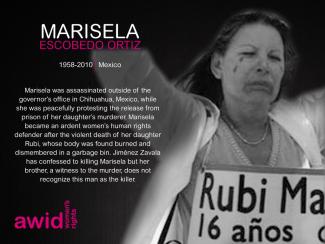
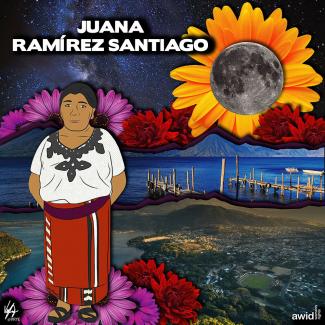
Juana was one of the founders and current Board Member of Red de Mujeres Ixiles de Nebaj, an Indigenous women’s rights organization that is a member of the Mesoamerican Initiative of WHRDs (IM-Defensoras).
She was also a midwife and a mother of 7 children. Juana had received death threats that were reported to the Prosecutor’s office. Juana is the third Indigenous WHRD murdered in the area during 2018. The Guatemala Ombudsman reports that a total of 20 HRDs were killed in the country this year.
Juana Ramírez Santiago was shot dead by unidentified attackers while crossing a bridge in Nebak, Quiché, Guatemala. Investigations to identify the perpetrators are ongoing.
Upasana Agarwal
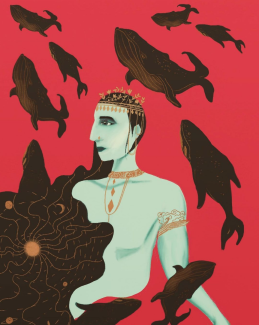
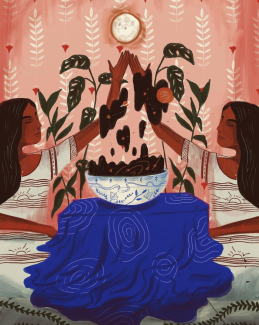
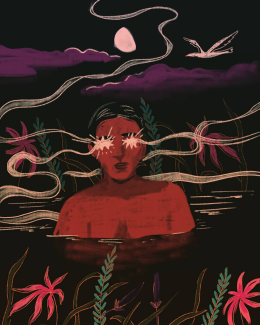
Forgotten Song (Chanson Oubliée)Ode to the Moon (Ode à la Lune)Vapour and Fire (Vapeur et Feu)
À propos d’Upasana Agarwal
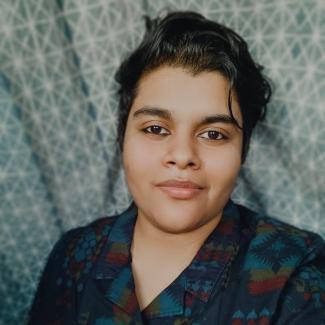
Upasana est un·e illustrateurice et artiste non binaire basé·e à Kolkata, en Inde. Son travail explore l'identité et les récits personnels en partant d’un vestige visuel ou d’une preuve des contextes avec lesquels iel travaille. Iel est particulièrement attiré·e par les motifs qui, selon Upasana, communiquent des vérités complexes sur le passé, le présent et l'avenir. Quand Upasana n'est pas en train de dessiner, iel organise et dirige un centre d'art communautaire queer et trans dans la ville.
Our values - Human Rights
Human rights
We believe in a full application of the principle of rights including those enshrined in international laws and affirm the belief that all human rights are interrelated, interdependent and indivisible. We are committed to working towards the eradication of all discriminations based on gender, sexuality, religion, age, ability, ethnicity, race, nationality, class or other factors.
Âurea Mouzinho est une organisatrice féministe dans le domaine de la justice économique. Originaire de Louanda en Angola, elle compte 10 ans de carrière dans la recherche, le subventionnement, le plaidoyer et le renforcement de mouvement pour les droits des femmes et la justice économique en Afrique et dans le Sud global. Actuelle responsable des programmes pour l’Afrique chez Thousand Currents, elle participe également au comité de rédaction de Feminist Africa et est membre d’Ondjango Feminista, un collectif féministe qu’elle a co-fondé en 2016. Tout juste maman d’un petit garçon Gémeaux, Ȃurea aime les journées tranquilles avec sa petite famille et les longues promenades sur la plage. Il lui arrive parfois de tweeter via son compte @kitondowe.