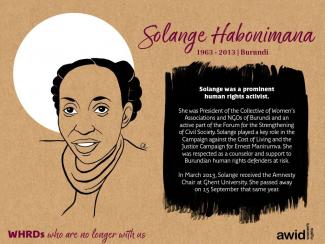
Solange Habonimana
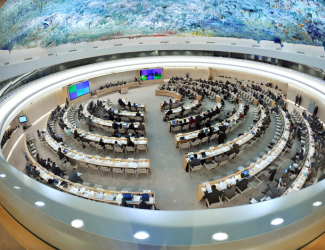
The Human Rights Council (HRC) is the key intergovernmental body within the United Nations system responsible for the promotion and protection of all human rights around the globe. It holds three regular sessions a year: in March, June and September. The Office of the UN High Commissioner for Human Rights (OHCHR) is the secretariat for the HRC.
Debating and passing resolutions on global human rights issues and human rights situations in particular countries
Examining complaints from victims of human rights violations or activist organizations on behalf of victims of human rights violations
Appointing independent experts (known as “Special Procedures”) to review human rights violations in specific countries and examine and further global human rights issues
Engaging in discussions with experts and governments on human rights issues
Assessing the human rights records of all UN Member States every four and a half years through the Universal Periodic Review
AWID works with feminist, progressive and human rights partners to share key knowledge, convene civil society dialogues and events, and influence negotiations and outcomes of the session.
 Le financement des mouvements féministes est indispensable à la mise en place d’une présence plus juste et pacifique et d’un avenir libéré. Au cours de la dernière décennie, les bailleurs de fonds se sont engagés à verser bien plus d’argent en faveur de l’égalité des genres, mais 1 % seulement des financements philanthropiques et de développement a réellement été destiné à financer directement les changements sociaux menés par des féministes (ressource en anglais).
Pour viser l’abondance, et rompre ce cycle d’insuffisance chronique, l’enquête WITM est une invitation pour les activistes féministes et défenseur·ses de la justice de genre à se lancer dans l’aventure de la collecte de données probantes et d’arguments en faveur de la mobilisation de davantage d’argent, de meilleure qualité, et de réappropriation du pouvoir au sein de l’écosystème actuel du financement. En solidarité avec les mouvements qui continuent à être invisibilisés, marginalisés et empêchés d’accéder à des financements de base, à long terme, flexibles et reposant sur la confiance, l’enquête WITM souligne l’état actuel de la mobilisation de ressources, remet en question les fausses solutions, et identifie les changements à opérer au sein des modèles de financement afin que les mouvements s’épanouissent et relèvent les défis complexes de notre époque.
Durante décadas, lxs investigadorxs y activistas feministas han articulado conceptos importantes en relación al género para entender y cuestionar la opresión y la discriminación. Ahora, esos conceptos se han convertido en el blanco de los actores anti-derechos, quienes afirman que los roles de género patriarcales y opresivos son de «sentido común» y, estratégicamente, presentan a todas las otras ideas, normas culturales y formas de vida social como una peligrosa ideología conspirativa.
Lee nuestro resumen Narrativas sobre la «Ideología de género»: Una amenaza para los derechos humanos
Articulate feminist visions, proposals and agendas for resourcing justice.
ÉCONOMIES DES SOINS AGROÉCOLOGIE ET SOUVERAINETÉ ALIMENTAIRECOOPÉRATIVISME FÉMINISTESYNDICALISME FÉMINISTE
.
Les groupes, organisations et mouvements qui travaillent spécifiquement, ou principalement, à la défense des droits des femmes et des filles, pour la justice de genre, pour la défense des droits des personnes LBTQI+ et des allié·es dans toutes les régions et à tous les niveaux, que ces structures soient récentes ou non.
When you come to the center of São Paulo, you will see the building of the Ocupação 9 de Julho - a landmark in the struggle for social housing and an important cultural site. This is the work of The Homeless Workers Movement (Movimento dos Sem-Teto do Centro, MSTC) a movement of over 2000 people that operates in the city center and converts abandoned spaces into housing for low-income workers, children, women, adults, the elderly, migrants and refugees. In this particular building, they provide food and shelter to 122 families.

External funding includes grants and other forms of funding from philanthropic foundations, governments, bilateral, multilateral or corporate funders and individual donors – from both within your country or abroad. It excludes resources that groups, organizations and/or movements generate autonomously such as, for example, membership fees, the voluntary contributions of staff, members and/or supporters, community fundraisers, venue hires or sale of services. For ease and clarity, definitions of the different types of funding as well as short descriptions of different donors are included in the survey.
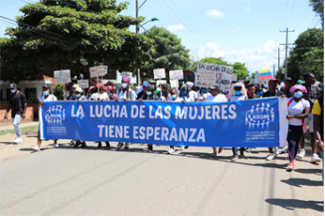
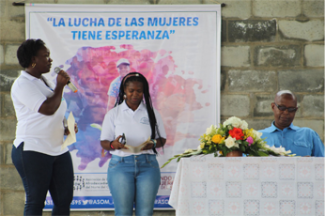
Asociación de Mujeres Afrodescendientes del Norte del Cauca (ASOM)
AWID tiene un compromiso con la justicia lingüística y, en este punto, lamentamos no poder contar con más idiomas para la encuesta ¿Dónde está el dinero? Sin embargo, en caso de que necesites asistencia con la traducción o desees responder la encuesta en otro idioma, te pedimos que nos contactes al email witm@awid.org.
 |
 |
 |
 |
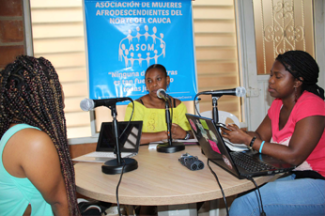 |
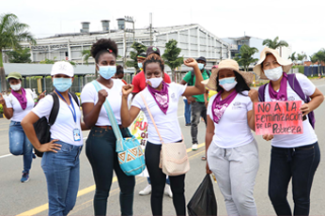
Les militants de l'ASOM dans les rencontres, les défilés et les événements