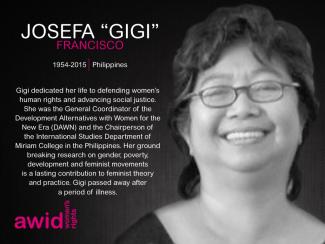
Josefa "Gigi" Francisco
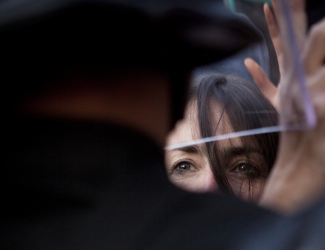
WHRDs are self-identified women and lesbian, bisexual, transgender, queer and intersex (LBTQI) people and others who defend rights and are subject to gender-specific risks and threats due to their human rights work and/or as a direct consequence of their gender identity or sexual orientation.
WHRDs are subject to systematic violence and discrimination due to their identities and unyielding struggles for rights, equality and justice.
The WHRD Program collaborates with international and regional partners as well as the AWID membership to raise awareness about these risks and threats, advocate for feminist and holistic measures of protection and safety, and actively promote a culture of self-care and collective well being in our movements.
WHRDs are exposed to the same types of risks that all other defenders who defend human rights, communities, and the environment face. However, they are also exposed to gender-based violence and gender-specific risks because they challenge existing gender norms within their communities and societies.
We work collaboratively with international and regional networks and our membership
We aim to contribute to a safer world for WHRDs, their families and communities. We believe that action for rights and justice should not put WHRDs at risk; it should be appreciated and celebrated.
Promoting collaboration and coordination among human rights and women’s rights organizations at the international level to strengthen responses concerning safety and wellbeing of WHRDs.
Supporting regional networks of WHRDs and their organizations, such as the Mesoamerican Initiative for WHRDs and the WHRD Middle East and North Africa Coalition, in promoting and strengthening collective action for protection - emphasizing the establishment of solidarity and protection networks, the promotion of self-care, and advocacy and mobilization for the safety of WHRDs;
Increasing the visibility and recognition of WHRDs and their struggles, as well as the risks that they encounter by documenting the attacks that they face, and researching, producing, and disseminating information on their struggles, strategies, and challenges:
Mobilizing urgent responses of international solidarity for WHRDs at risk through our international and regional networks, and our active membership.
 |
Assembly as Pleasure: Weaving Feminist Collaborative ProjectsGhiwa Sayegh, Kohl: A Journal for Body and Gender Research Witchcraft, shamanism and other insurgent knowledge against patriarchySofía Blanco Sixtos, Colectiva Feminista MAPAS |
Second Dialogue de haut niveau sur le financement du développement
Activists reflection & solidarity circle
✉️ By registration only. Register here
📅 Friday, March 14, 2025
🕒 12.00-2.00pm EST
🏢 Blue Gallery, The Blue Building, 222 East 46th Street
🎙️Facilitated by: Gopika Bashi, AWID Director of Programs
Organizer: Count Me In! Consortium
Janet Benshoof fue una abogada de derechos humanos de los Estados Unidos, y defensora de la igualdad de las mujeres y de los derechos sexuales y reproductivos.
Hizo campaña para ampliar el acceso a los anticonceptivos y al aborto en todo el mundo, y luchó contra las sentencias antiaborto y en el territorio estadounidense de Guam. Fue arrestada en 1990 por oponerse a la ley de aborto más restrictiva de su país. Sin embargo, obtuvo una medida cautelar en el tribunal local de Guam que bloqueó la ley y, finalmente, ganó en el Tribunal de Apelaciones del Noveno Circuito, que llevó a la anulación de la ley para siempre.
"Las mujeres de Guam están en una situación muy trágica. No tengo intención de callarme al respecto." - Janet Benshoof para la revista People.
Janet sentó precedentes jurídicos históricos, entre ellos, la aprobación de la anticoncepción de emergencia por parte de la Administración de Alimentos y Medicamentos de los Estados Unidos, así como la aplicación del derecho internacional para garantizar los derechos de las víctimas de violación en el Tribunal Superior de Iraq, durante el procesamiento de los crímenes de guerra de la época de Saddam.
Janet fue Presidenta y fundadora del Centro de Justicia Global, y fundadora también del Centro de Derechos Reproductivos, la primera organización internacional de derechos humanos del mundo centrada en la elección y la equidad reproductiva. Durante 15 años se desempeñó como directora del Proyecto de Derechos Reproductivos de la Unión Americana de Libertades Civiles, donde encabezó litigios que dieron forma a las leyes constitucionales de los Estados Unidos sobre igualdad de género, libertad de expresión y derechos reproductivos.
"Janet era conocida por su mente jurídica brillante, su agudo sentido del humor y su coraje ante la injusticia". - Anthony D. Romero
Nombrada una de las "100 Abogadas más influyentes de América" por el National Law Journal, Janet recibió numerosos premios y honores.
Nació en mayo de 1947 y falleció en diciembre de 2017.
The Sixth High-level Dialogue on Financing for Development, 7-8 October 2013 focused on reviewing the progress of MDG’s, and identifying gaps to be addressed in discussions on the new development framework.
A report by the MDG’s Gap Task Force launched during the session pointed to the failure to meet MDG 8 (Global Partnership for Development) as a major factor in the challenges to meeting the MDGs. The report showed that more focus should be given to developing stronger global partnerships that would ensure binding commitments for the new development framework post 2015.

Filter for funders that support initiatives in your geographical area.
Juli Dugdale était une féministe australienne pratiquant un leadership intergénérationnel ancré dans les principes du féminisme, de l’inclusion et de l’égalité. Elle était une leader, une pair et une encadrante pour de nombreuses femmes, et particulièrement des jeunes femmes du monde entier.
Juli a été une membre dévouée de l’équipe de l’Association des jeunes femmes chrétiennes (YWCA), bénévole et fervente défenseure du leadership des jeunes femmes pendant plus de 30 ans.
Elle assurait un lien très fort entre le mouvement australien du YWCA et le bureau international. Sa confiance dans les capacités de leadership des jeunes femmes a entre autres donné lieu à un partenariat pluriannuel avec le ministère australien des Affaires étrangères et du Commerce, de même qu’à la rédaction du manuel Rise Up, un guide mondial pour le leadership transformationnel des jeunes femmes, lancé en 2018.
Juli est décédée à Genève, en Suisse, le 12 août 2019.
« Pour celles et ceux qui ont travaillé avec Juli, ce fut un privilège. Pour celles et ceux qui n’ont pas travaillé avec elle, sachez que son héritage perdure dans le travail que nous faisons tous les jours, et dans la mission du mouvement des YWCA. » – YWCA Australie
« Juli Dugdale occupera toujours une place privilégiée dans le cœur de nombreuses personnes du mouvement du YWCA, particulièrement ici en Aotearoa et dans le Pacifique. Juli entretenait une relation particulière avec le Pacifique, et soutenait de manière remarquable les jeunes femmes de la région. De nature humble, aimable, aimante, affectueuse, dévouée et passionnée, elle avait un cœur généreux. Elle incarnait la vision du « leadership transformationnel » du YWCA avec une vision et une clairvoyance extraordinaires, et a de plus aidé à renforcer les capacités de générations de jeunes femmes leaders dans le monde. » – YWCA Nouvelle-Zélande
Dans cette sélection de films, vous découvrirez les voix de réalisatrices qui ne se contentent pas de restituer les réalités féministes palpitant dans chaque recoin de ce territoire vaste et divers, mais explorerez aussi des oeuvres qui, dans leur conception même, s'interrogent sur le pourquoi, le qui et le comment du cinéma ou de l'audiovisuel. Ces femmes comprennent le cinéma comme un outil de lutte, comme quelque chose de plus que de simples images à apprécier sur un écran. Pour ces réalisatrices ou collectifs de cinéastes, le cinéma et l'audiovisuel constituent un outil capable de promouvoir la discussion, d'ouvrir un débat, bref, une ressource pour la pédagogie populaire et féministe.
Sesiones adicionales de consulta sobre el Borrador del Documento Final
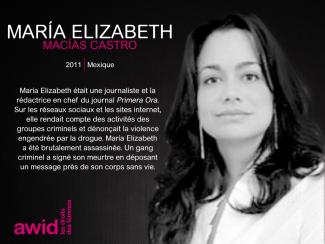
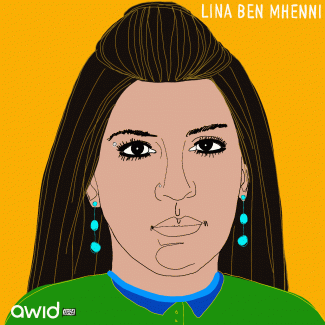
“I want to tell all Tunisians: We have to unite to say no to censorship and opinion trials.” - Lina Ben Mhenni (2013 interview)
“It’s true that information and the internet are important but being on the ground is crucial for a revolution. Some people here in Tunisia think that change can occur just by clicking like on the internet. I believe you have to be active on the ground. And of course, join actions on the field with the action on the web.” - Lina Ben Mhenni (Interview in POCIT)
In 2010, she co-organized a protest that challenged the government suppression of media and internet censorship. Lina was widely known for her blog “A Tunisian Girl” and recognized for her work during the Tunisian revolution in 2011. In her blog, she reported on the news from the uprising, shared images documenting protests and was among the few voices who spoke about the killings and crackdown on protesters in Sidi Bouzid. Lina blogged using her real name instead of a pseudonym to protect her identity, one of only a few bloggers to do so.
“Our freedom of expression is in real danger. I am afraid that we are losing the unique fruits of the revolution: the disappearance of fear and our freedom of speech. We have to keep on fighting to protect and preserve this right.” — Lina Ben Mhenni (2013 interview)
Lina was only 36 years old when she passed away on 27 January 2020, as a result of complications from an autoimmune disease.
"Freedom, better education and health - that's all we wanted. When we failed, she pushed us." Lina’s school teacher Hala.
Consultez notre guide : « Un tout petit guide pour l’organisation de festivals féministes internationaux et d’événements en ligne. »
Rejoignez le Groupe de travail des femmes sur le financement du développement (site en anglais) pour en savoir plus sur leur contribution au processus sur le FdD (ou envoyez un email à l’adresse suivante : wwgonffd@gmail.com) ;
Rejoignez le Groupe des OSC sur le FdD (ou envoyez un email à l’adresse addiscoordinatinggroup@gmail.com pour demander à vous joindre au groupe Google suivant : https://groups.google.com/forum/#!forum/global-social-economy).
D'autres liens importants :
Thanks to our global feminist community! From May to August 2024, nearly 1,200 organizations working for Women's rights, gender justice, and LBTQI+ equality shared their experiences in the WITM survey. The results offer a unique picture of how feminist movements are resourced and where gaps remain.